Ch. 10 - Sequences and Infinite Series
Briggs - Calculus: Early Transcendentals 3rd Edition
Briggs3rd EditionCalculus: Early TranscendentalsISBN: 9780136847243당신이 사용하는 게 아니라요?교과서 변경
10장, 문제 10.4.11

9–16. Divergence Test Use the Divergence Test to determine whether the following series diverge or state that the test is inconclusive.
∑ (k = 0 to ∞) 1 / (1000 + k)

검증된 단계별 안내
1
Identify the general term of the series, which is given by \(a_k = \frac{1}{1000 + k}\).
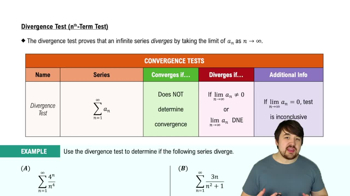
Recall the Divergence Test (also known as the nth-term test for divergence), which states: If \(\lim_{k \to \infty} a_k \neq 0\), then the series \(\sum a_k\) diverges. If the limit equals zero, the test is inconclusive.
Calculate the limit of the general term as \(k\) approaches infinity: \(\lim_{k \to \infty} \frac{1}{1000 + k}\).
Evaluate the limit by considering the behavior of the denominator as \(k\) becomes very large.
Based on the value of the limit, conclude whether the Divergence Test shows the series diverges or if the test is inconclusive.

비슷한 문제에 대한 검증된 영상 답변:

이 영상 해법은 위 문제에 도움이 된다고 튜터들이 추천한 것입니다.
영상 길이:
1m
도움이 되었나요?

주요 개념

질문에 올바르게 답하기 위해 반드시 이해해야 하는 핵심 개념들은 다음과 같습니다.

Divergence Test

The Divergence Test states that if the limit of the terms of a series does not approach zero as k approaches infinity, then the series diverges. If the limit is zero, the test is inconclusive, and other methods must be used to determine convergence or divergence.
추천 영상:
가이드 코스
05:44
Divergence Test (nth Term Test)

Behavior of the General Term

Analyzing the general term of the series, 1/(1000 + k), involves understanding its limit as k approaches infinity. Since the denominator grows without bound, the term approaches zero, which means the Divergence Test cannot confirm divergence in this case.
추천 영상:
가이드 코스
05:44
Divergence Test (nth Term Test)

Comparison to Harmonic Series

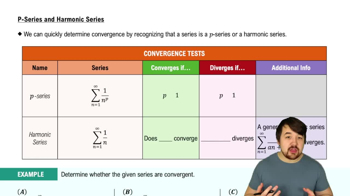
The series ∑ 1/(1000 + k) resembles the harmonic series ∑ 1/k, which is known to diverge. Recognizing this similarity helps in concluding that despite terms approaching zero, the series diverges by comparison to a known divergent series.
추천 영상:
가이드 코스
04:30
P-Series and Harmonic Series
관련 실천
교과서 질문

13–52. Limits of sequences

Find the limit of the following sequences or determine that the sequence diverges.


{bₙ}, where

bₙ = { n / (n + 1)if n ≤ 5000

ne⁻ⁿif n > 5000 }

67
views

교과서 질문

11–27. Alternating Series Test Determine whether the following series converge.

∑ (k = 1 to ∞) (−1)ᵏ⁺¹ k¹/ᵏ

68
views
교과서 질문

21–42. Geometric series Evaluate each geometric series or state that it diverges.  


29.∑ (k = 1 to ∞) e^(–2k)

69
views
교과서 질문

32–49. Choose your test Use the test of your choice to determine whether the following series converge absolutely, converge conditionally, or diverge.

∑ (from k = 1 to ∞) k¹⁰⁰ / (k + 1)!

47
views
교과서 질문

9–36. Comparison tests Use the Comparison Test or the Limit Comparison Test to determine whether the following series converge.


∑ (k = 1 to ∞) (2 + (−1)ᵏ) / k²

36
views
교과서 질문

16–17. {Use of Tech} Periodic savings

Suppose you deposit m dollars at the beginning of every month in a savings account that earns a monthly interest rate of r, which is the annual interest rate divided by 12 (for example, if the annual interest rate is 2.4%, r = 0.024/12 = 0.002). For an initial investment of m dollars, the amount of money in your account at the beginning of the second month is the sum of your second deposit and your initial deposit plus interest, or m + m(1 + r). Continuing in this fashion, it can be shown that the amount of money in your account after n months is


Aₙ = m + m(1 + r) + ⋯ + m(1 + r)ⁿ⁻¹.


Use geometric sums to determine the amount of money in your savings account after 5 years (60 months) using the given monthly deposit and interest rate.


17. Monthly deposits of \$250 at a monthly interest rate of 0.2%

67
views