
Ch. 10 - Sequences and Infinite Series
Briggs - Calculus: Early Transcendentals 3rd Edition
Briggs3rd EditionCalculus: Early TranscendentalsISBN: 9780136847243당신이 사용하는 게 아니라요?교과서 변경
10장, 문제 10.4.47d

Explain why or why not Determine whether the following statements are true and give an explanation or counterexample.


d. Every partial sum Sₙ of the series ∑ (k = 1 to ∞) 1 / k² underestimates the exact value of ∑ (k = 1 to ∞) 1 / k².

검증된 단계별 안내
1
Recall that the series \( \sum_{k=1}^\infty \frac{1}{k^2} \) is a convergent series with positive terms, known as the p-series with \( p = 2 > 1 \).
The partial sum \( S_n = \sum_{k=1}^n \frac{1}{k^2} \) represents the sum of the first \( n \) terms of the series.
Since all terms \( \frac{1}{k^2} > 0 \), the sequence of partial sums \( S_n \) is strictly increasing, meaning \( S_1 < S_2 < S_3 < \cdots \).
Because the series converges to a finite limit \( S = \sum_{k=1}^\infty \frac{1}{k^2} \), and the partial sums increase towards this limit, each partial sum \( S_n \) must be less than or equal to \( S \).
Therefore, every partial sum \( S_n \) underestimates the exact value of the infinite series \( \sum_{k=1}^\infty \frac{1}{k^2} \), making the statement true.

비슷한 문제에 대한 검증된 영상 답변:

이 영상 해법은 위 문제에 도움이 된다고 튜터들이 추천한 것입니다.
영상 길이:
1m
도움이 되었나요?

주요 개념

질문에 올바르게 답하기 위해 반드시 이해해야 하는 핵심 개념들은 다음과 같습니다.

Partial Sums of Infinite Series

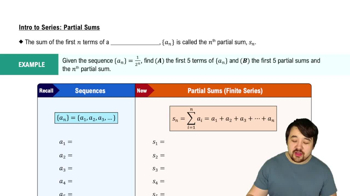
A partial sum Sₙ is the sum of the first n terms of an infinite series. It approximates the total sum, and understanding how these sums behave helps determine if they overestimate or underestimate the series' exact value.
추천 영상:
가이드 코스
06:45
Intro to Series: Partial Sums

Convergence and Monotonicity of Series

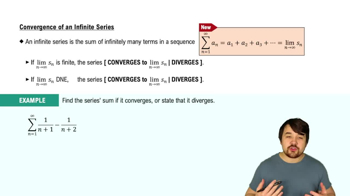
A series converges if its partial sums approach a finite limit. For series with positive, decreasing terms like 1/k², partial sums are increasing and approach the limit from below, which affects whether they underestimate or overestimate the total sum.
추천 영상:
가이드 코스
06:52
Convergence of an Infinite Series

Comparison and Counterexamples in Series Analysis

To verify statements about series, one uses comparison tests or constructs counterexamples. For the series ∑ 1/k², known results and inequalities help confirm if partial sums underestimate the total sum or not.
추천 영상:
가이드 코스
06:00
Geometric Series
관련 실천
교과서 질문

87. Explain why or why not

Determine whether the following statements are true and give an explanation or counterexample.


e. ∑ (k = 1 to ∞) (π / e)⁻ᵏ is a convergent geometric series.

45
views
교과서 질문

41–44. {Use of Tech} Remainders and estimates Consider the following convergent series.


d. Find an interval in which the value of the series must lie if you approximate it using ten terms of the series.


41. ∑ (k = 1 to ∞) 1 / k⁶

60
views
교과서 질문

Explain why or why not Determine whether the following statements are true and give an explanation or counterexample.

d. When applying the Limit Comparison Test, an appropriate comparison series for ∑ (k = 1 to ∞) (k² + 2k + 1) / (k⁵ + 5k + 7) is ∑ (k = 1 to ∞) 1 / k³.

31
views
교과서 질문

87. Explain why or why not

Determine whether the following statements are true and give an explanation or counterexample.


d. If ∑ pᵏ diverges, then ∑ (p + 0.001)ᵏ diverges, for a fixed real number p.

44
views
교과서 질문

Explain why or why not Determine whether the following statements are true and give an explanation or counterexample.


d. The Ratio Test is always inconclusive when applied to ∑ aₖ, where aₖ is a nonzero rational function of k.

48
views
교과서 질문

Explain why or why not

Determine whether the following statements are true and give an explanation or counterexample.


d.If {aₙ} = {1, ½, ⅓, ¼, ⅕, …} and

{bₙ} = {1, 0, ½, 0, ⅓, 0, ¼, 0, …},

then limₙ→∞aₙ = limₙ→∞bₙ.

43
views