Ch. 10 - Sequences and Infinite Series
Briggs - Calculus: Early Transcendentals 3rd Edition
Briggs3rd EditionCalculus: Early TranscendentalsISBN: 9780136847243당신이 사용하는 게 아니라요?교과서 변경
10장, 문제 10.1.5

Find two different explicit formulas for the sequence {1, -2, 3, -4, -5 .....}

검증된 단계별 안내
1
First, observe the pattern of the sequence: the terms alternate in sign and increase in absolute value by 1 each time. The sequence is {1, -2, 3, -4, 5, -6, ...}. Note that the sign alternates and the magnitude is simply the term's position in the sequence.
To capture the alternating sign, use the factor \((-1)^{n+1}\) or \((-1)^{n}\), since these expressions alternate between +1 and -1 as \(n\) increases. For example, \((-1)^{n+1}\) is positive when \(n\) is odd and negative when \(n\) is even.
The magnitude of each term is just \(n\), the position in the sequence. So one explicit formula can be written as \(a_n = (-1)^{n+1} \times n\).
For a second explicit formula, consider using the floor or ceiling functions or an expression involving powers of \(-1\) in a different way. For example, you can write \(a_n = (-1)^{n+1} \cdot n\) or \(a_n = (-1)^{n+1} \cdot n\) (which is the same), so try expressing the sign as \(1 - 2(n \bmod 2)\) or \((-1)^n\) with a shift in \(n\) to get the sign pattern.
Another way is to write the sign as \((-1)^{n+1}\) and the magnitude as \(n\), or alternatively, use \(a_n = (-1)^{n+1} \cdot n\) and \(a_n = (-1)^{n+1} \cdot n\) but with \(n\) replaced by \(n\) or \(n\) shifted by 1, depending on the indexing. The key is to express the alternating sign and the magnitude explicitly.

비슷한 문제에 대한 검증된 영상 답변:

이 영상 해법은 위 문제에 도움이 된다고 튜터들이 추천한 것입니다.
영상 길이:
2m
도움이 되었나요?

주요 개념

질문에 올바르게 답하기 위해 반드시 이해해야 하는 핵심 개념들은 다음과 같습니다.

Sequences and Explicit Formulas

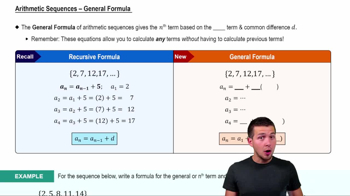
A sequence is an ordered list of numbers following a specific pattern. An explicit formula defines the nth term directly as a function of n, allowing calculation of any term without knowing previous terms.
추천 영상:
5:17
Arithmetic Sequences - General Formula

Alternating Sign Patterns

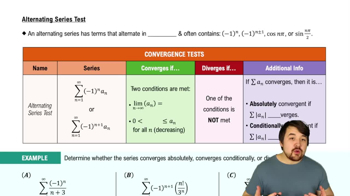
Alternating sign sequences switch between positive and negative values, often modeled using powers of -1, such as (-1)^n or (-1)^{n+1}, to represent the sign change at each term.
추천 영상:
가이드 코스
10:54
Alternating Series Test

Piecewise and General Term Construction

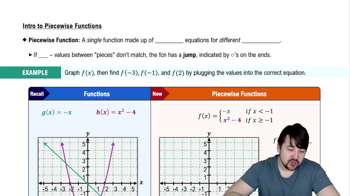
Constructing explicit formulas may involve combining absolute values, powers, or piecewise definitions to capture complex patterns, such as alternating signs combined with increasing magnitudes.
추천 영상:
가이드 코스
05:36
Piecewise Functions