
Ch. 10 - Sequences and Infinite Series
Briggs - Calculus: Early Transcendentals 3rd Edition
Briggs3rd EditionCalculus: Early TranscendentalsISBN: 9780136847243당신이 사용하는 게 아니라요?교과서 변경
10장, 문제 10.4.65b

Loglog p-series Consider the series ∑ (k = 2 to ∞) 1 / (k(ln k)(ln ln k)ᵖ), where p is a real number.
b. Which of the following series converges faster? Explain.
∑ (k = 2 to ∞) 1 / (k(ln k)²) or ∑ (k = 3 to ∞) 1 / (k(ln k)(ln ln k)²)?

검증된 단계별 안내
1
Step 1: Understand the two series given for comparison. The first series is \( \sum_{k=2}^\infty \frac{1}{k (\ln k)^2} \) and the second series is \( \sum_{k=3}^\infty \frac{1}{k (\ln k) (\ln \ln k)^2} \). Both are infinite series with terms involving logarithmic functions in the denominator.
Step 2: Recall that the speed of convergence of a series depends on how quickly its terms approach zero. Smaller terms generally mean faster convergence. So, we want to compare the size of the terms \( \frac{1}{k (\ln k)^2} \) and \( \frac{1}{k (\ln k) (\ln \ln k)^2} \) for large \( k \).
Step 3: For large \( k \), note that \( \ln k > 0 \) and \( \ln \ln k > 0 \). Since \( (\ln k)^2 \) grows faster than \( (\ln k)(\ln \ln k)^2 \) because \( (\ln \ln k)^2 \) grows slower than \( \ln k \), the denominator \( k (\ln k)^2 \) is larger than \( k (\ln k)(\ln \ln k)^2 \) for sufficiently large \( k \).
Step 4: Since the denominator of the first series' terms is larger, its terms are smaller compared to the second series' terms for large \( k \). Smaller terms imply that the first series converges faster than the second series.
Step 5: To confirm this rigorously, one could apply the Integral Test or compare the series using the Limit Comparison Test by examining the limit of the ratio of their terms as \( k \to \infty \). This will show which series' terms decrease faster, confirming the conclusion about convergence speed.

비슷한 문제에 대한 검증된 영상 답변:

이 영상 해법은 위 문제에 도움이 된다고 튜터들이 추천한 것입니다.
영상 길이:
5m

주요 개념

질문에 올바르게 답하기 위해 반드시 이해해야 하는 핵심 개념들은 다음과 같습니다.

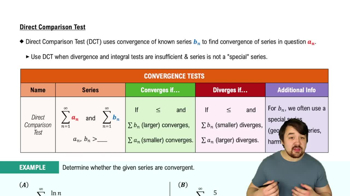
Comparison Test for Series Convergence

The Comparison Test helps determine the convergence of a series by comparing it to another series with known behavior. If a series has terms smaller than those of a convergent series, it also converges. Conversely, if its terms are larger than those of a divergent series, it diverges. This test is useful for comparing the speed of convergence between series.
추천 영상:
가이드 코스
09:25
Direct Comparison Test

Logarithmic and Log-Logarithmic Series

Logarithmic and log-logarithmic series involve terms with logarithmic functions in the denominator, such as ln(k) and ln(ln(k)). These series converge very slowly, and their convergence depends sensitively on the powers of these logarithmic terms. Understanding how these nested logarithms affect term size is key to analyzing convergence rates.
추천 영상:
7:30
Logarithms Introduction

Rate of Convergence

The rate of convergence describes how quickly the partial sums of a series approach the series limit. Series with terms that decrease faster converge more quickly. Comparing terms like 1/(k(ln k)^2) and 1/(k(ln k)(ln ln k)^2) involves analyzing which denominator grows faster, thus indicating which series converges faster.
추천 영상:
가이드 코스
04:16
Intro To Related Rates
관련 실천
교과서 질문

67–70. Formulas for sequences of partial sums Consider the following infinite series.


b.Find a formula for the nth partial sum Sₙ of the infinite series. Use this formula to find the next four partial sums S₅, S₆, S₇, S₈ of the infinite series.


∑⁽∞⁾ₖ₌₁2⁄[(2k − 1)(2k + 1)]

90
views
교과서 질문

41–44. {Use of Tech} Remainders and estimates Consider the following convergent series.


b. Find how many terms are needed to ensure that the remainder is less than 10⁻³.


43. ∑ (k = 1 to ∞) 1 / 3ᵏ

134
views
교과서 질문

Explain why or why not Determine whether the following statements are true and give an explanation or counterexample.


b. A series that converges absolutely must converge.

64
views
교과서 질문

27–34. Working with sequences Several terms of a sequence {aₙ}ₙ₌₁∞ are given.

b. Find a recurrence relation that generates the sequence (supply the initial value of the index and the first term of the sequence).

{-5, 5, -5, 5, ......}

54
views
교과서 질문

Explain why or why not Determine whether the following statements are true and give an explanation or counterexample.


b. The sum ∑ (k = 3 to ∞) 1 / √(k − 2) is a p-series.

41
views
교과서 질문

72–75. {Use of Tech} Practical sequences

Consider the following situations that generate a sequence


b.Find an explicit formula for the terms of the sequence.


Radioactive decay

A material transmutes 50% of its mass to another element every 10 years due to radioactive decay. Let Mₙ be the mass of the radioactive material at the end of the nᵗʰ decade, where the initial mass of the material is M₀ = 20g.

44
views