Ch. 11 - Power Series
Briggs - Calculus: Early Transcendentals 3rd Edition
Briggs3rd EditionCalculus: Early TranscendentalsISBN: 9780136847243당신이 사용하는 게 아니라요?교과서 변경
11장, 문제 11.R.46

Binomial series Write out the first three terms of the Maclaurin series for the following functions.
ƒ(x) = (1 + 2x)^(-5)

검증된 단계별 안내
1
Recall that the Maclaurin series is a special case of the Taylor series expanded at \(x = 0\). For a function \(f(x)\), the Maclaurin series is given by \(f(x) = \sum_{n=0}^{\infty} \frac{f^{(n)}(0)}{n!} x^n\).
Recognize that the function \(f(x) = (1 + 2x)^{-5}\) can be expanded using the binomial series formula for negative integer exponents: \( (1 + u)^k = \sum_{n=0}^{\infty} \binom{k}{n} u^n \), where \(k = -5\) and \(u = 2x\).
Write the general term of the binomial series for this function as \( \binom{-5}{n} (2x)^n \), where the binomial coefficient for negative integers is defined as \( \binom{k}{n} = \frac{k (k-1) (k-2) \cdots (k - n + 1)}{n!} \).
Calculate the first three terms by substituting \(n = 0, 1, 2\) into the general term: - For \(n=0\): \(\binom{-5}{0} (2x)^0\) - For \(n=1\): \(\binom{-5}{1} (2x)^1\) - For \(n=2\): \(\binom{-5}{2} (2x)^2\).
Simplify each term by evaluating the binomial coefficients and powers of \$2x$ to write out the first three terms of the Maclaurin series explicitly.

비슷한 문제에 대한 검증된 영상 답변:

이 영상 해법은 위 문제에 도움이 된다고 튜터들이 추천한 것입니다.
영상 길이:
3m
도움이 되었나요?

주요 개념

질문에 올바르게 답하기 위해 반드시 이해해야 하는 핵심 개념들은 다음과 같습니다.

Maclaurin Series

The Maclaurin series is a special case of the Taylor series expanded at x = 0. It represents a function as an infinite sum of terms calculated from the derivatives of the function at zero. Writing out the first few terms involves evaluating the function and its derivatives at zero and expressing them as powers of x.
추천 영상:
08:26
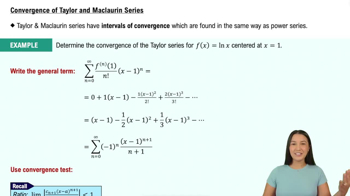
Convergence of Taylor & Maclaurin Series

Binomial Series Expansion

The binomial series generalizes the binomial theorem to any real exponent, allowing expansion of expressions like (1 + x)^n where n can be negative or fractional. It expresses the function as an infinite sum involving binomial coefficients, which are calculated using combinations or the generalized formula for non-integer powers.
추천 영상:
가이드 코스
06:00
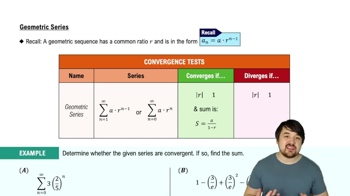
Geometric Series

Calculating Binomial Coefficients for Negative Powers

For negative integer exponents, binomial coefficients are computed using the formula involving factorials or the generalized binomial coefficient definition. These coefficients determine the sign and magnitude of each term in the series, crucial for correctly expanding functions like (1 + 2x)^(-5).
추천 영상:
04:09
The Power Rule: Negative & Rational Exponents