
Ch. 11 - Power Series
Briggs - Calculus: Early Transcendentals 3rd Edition
Briggs3rd EditionCalculus: Early TranscendentalsISBN: 9780136847243당신이 사용하는 게 아니라요?교과서 변경
11장, 문제 11.4.51

Evaluating an infinite series Let f(x) = (eˣ − 1)/x, for x ≠ 0, and f(0)=1. Use the Taylor series for f centered at 0 to evaluate f(1) and to find the value of ∑ₖ₌₀∞ 1/(k+1)!

검증된 단계별 안내
1
Recognize that the function is given by \(f(x) = \frac{e^{x} - 1}{x}\) for \(x \neq 0\), and \(f(0) = 1\). Our goal is to find the Taylor series of \(f\) centered at 0, then use it to evaluate \(f(1)\) and the infinite sum \(\sum_{k=0}^{\infty} \frac{1}{(k+1)!}\).
Recall the Taylor series expansion of \(e^{x}\) centered at 0: \(e^{x} = \sum_{n=0}^{\infty} \frac{x^{n}}{n!}\). Substitute this into the expression for \(f(x)\) to write \(f(x)\) as a series:
\[f(x) = \frac{e^{x} - 1}{x} = \frac{\sum_{n=0}^{\infty} \frac{x^{n}}{n!} - 1}{x} = \frac{\sum_{n=1}^{\infty} \frac{x^{n}}{n!}}{x}.\]
Simplify the fraction by dividing each term in the numerator by \(x\): \(f(x) = \sum_{n=1}^{\infty} \frac{x^{n}}{n!} \cdot \frac{1}{x} = \sum_{n=1}^{\infty} \frac{x^{n-1}}{n!}\). Reindex the sum by letting \(k = n - 1\), so that:
\[f(x) = \sum_{k=0}^{\infty} \frac{x^{k}}{(k+1)!}.\]
To find \(f(1)\), substitute \(x=1\) into the series: \(f(1) = \sum_{k=0}^{\infty} \frac{1^{k}}{(k+1)!} = \sum_{k=0}^{\infty} \frac{1}{(k+1)!}\). This shows that the value of the infinite sum \(\sum_{k=0}^{\infty} \frac{1}{(k+1)!}\) is equal to \(f(1)\), which can be evaluated using the original function definition.

비슷한 문제에 대한 검증된 영상 답변:

이 영상 해법은 위 문제에 도움이 된다고 튜터들이 추천한 것입니다.
영상 길이:
5m
도움이 되었나요?

주요 개념

질문에 올바르게 답하기 위해 반드시 이해해야 하는 핵심 개념들은 다음과 같습니다.

Taylor Series Expansion

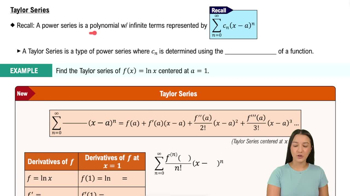
A Taylor series represents a function as an infinite sum of terms calculated from the derivatives at a single point. For a function f(x) centered at 0, it is expressed as f(x) = Σ (f⁽ᵏ⁾(0)/k!) xᵏ. This allows approximation and evaluation of functions like f(x) = (eˣ − 1)/x near zero.
추천 영상:
08:42
Taylor Series

Maclaurin Series for the Exponential Function

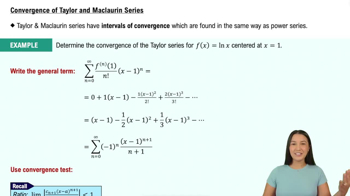
The Maclaurin series for eˣ is Σ (xᵏ / k!) from k=0 to ∞. Using this, eˣ − 1 can be written as Σ (xᵏ / k!) for k=1 to ∞. Dividing by x shifts the index, which helps express f(x) as a power series and evaluate it at specific points like x=1.
추천 영상:
08:26
Convergence of Taylor & Maclaurin Series

Infinite Series Summation and Evaluation

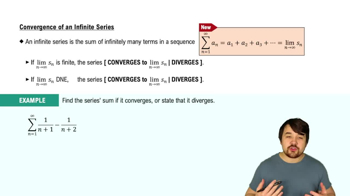
Evaluating infinite series involves recognizing patterns and using known series sums. Here, the series ∑ₖ₌₀∞ 1/(k+1)! corresponds to the sum of reciprocals of factorials shifted by one index, which relates to the exponential function minus 1. Understanding this helps find exact values of such sums.
추천 영상:
가이드 코스
06:52
Convergence of an Infinite Series
관련 실천
교과서 질문

Use of Tech Linear and quadratic approximation


a. Find the linear approximating polynomial for the following functions centered at the given point a.


b. Find the quadratic approximating polynomial for the following functions centered at a.


c Use the polynomials obtained in parts (a) and (b) to approximate the given quantity.


f(x) = 8x^(3/2), a=1; approximate 8 ⋅ 1.1^(3/2)

78
views
교과서 질문

Use of Tech Linear and quadratic approximation


a. Find the linear approximating polynomial for the following functions centered at the given point a.


b. Find the quadratic approximating polynomial for the following functions centered at a.


c Use the polynomials obtained in parts (a) and (b) to approximate the given quantity.


Find the Taylor polynomials p₁, …, p₅ centered at a=0 for f(x)=e⁻ˣ

37
views
교과서 질문

Use the Taylor series for cos x centered at 0 to verify that lim ₓ→ₐ (1− cos x)/x = 0.

119
views
교과서 질문

{Use of Tech} Approximations with Taylor polynomials


a. Approximate the given quantities using Taylor polynomials with n = 3.


b. Compute the absolute error in the approximation, assuming the exact value is given by a calculator.


e⁰ᐧ¹²

67
views
교과서 질문

Radius and interval of convergence Determine the radius and interval of convergence of the following power series.


∑ₖ₌₀∞ (x/3)ᵏ

42
views
교과서 질문

Radius and interval of convergence Determine the radius and interval of convergence of the following power series.


∑ₖ₌₂∞ ((x+3)ᵏ)/(k łn²k)

46
views