Ch. 11 - Power Series
Briggs - Calculus: Early Transcendentals 3rd Edition
Briggs3rd EditionCalculus: Early TranscendentalsISBN: 9780136847243당신이 사용하는 게 아니라요?교과서 변경
11장, 문제 11.4.54

Evaluating an infinite series Write the Maclaurin series for f(x) = ln (1+x) and find the interval of convergence. Evaluate f(−1/2) to find the value of ∑ₖ₌₁∞ 1/(k 2ᵏ)

검증된 단계별 안내
1
Recall that the Maclaurin series for a function \( f(x) \) is its Taylor series expansion at \( x = 0 \), given by \( f(x) = \sum_{n=0}^\infty \frac{f^{(n)}(0)}{n!} x^n \). For \( f(x) = \ln(1+x) \), start by finding the derivatives and evaluating them at 0 to identify the pattern of coefficients.
Use the known Maclaurin series expansion for \( \ln(1+x) \), which is \( \ln(1+x) = \sum_{k=1}^\infty (-1)^{k+1} \frac{x^k}{k} \). This series converges for \( -1 < x \leq 1 \).
Determine the interval of convergence by applying the ratio test or by recalling the domain of the logarithm series. The series converges when \( |x| < 1 \) and conditionally at \( x = 1 \), but diverges at \( x = -1 \).
To evaluate \( f(-\frac{1}{2}) = \ln(1 - \frac{1}{2}) = \ln(\frac{1}{2}) \), substitute \( x = -\frac{1}{2} \) into the series: \( \ln(1 - \frac{1}{2}) = \sum_{k=1}^\infty (-1)^{k+1} \frac{(-\frac{1}{2})^k}{k} \). Simplify the powers and signs to express the sum in terms of \( \sum_{k=1}^\infty \frac{1}{k 2^k} \).
Recognize that the series \( \sum_{k=1}^\infty \frac{1}{k 2^k} \) corresponds to the negative of the evaluated series (due to the alternating signs), so rearrange the expression to isolate \( \sum_{k=1}^\infty \frac{1}{k 2^k} \) and express it in terms of \( \ln(\frac{1}{2}) \).

비슷한 문제에 대한 검증된 영상 답변:

이 영상 해법은 위 문제에 도움이 된다고 튜터들이 추천한 것입니다.
영상 길이:
7m
도움이 되었나요?

주요 개념

질문에 올바르게 답하기 위해 반드시 이해해야 하는 핵심 개념들은 다음과 같습니다.

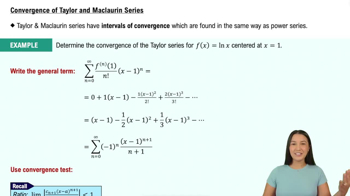
Maclaurin Series Expansion

The Maclaurin series is a Taylor series expansion of a function about x = 0. It expresses a function as an infinite sum of its derivatives at zero, multiplied by powers of x and divided by factorial terms. For ln(1+x), the series is derived by differentiating and evaluating at zero, providing a polynomial approximation valid near x = 0.
추천 영상:
08:26
Convergence of Taylor & Maclaurin Series

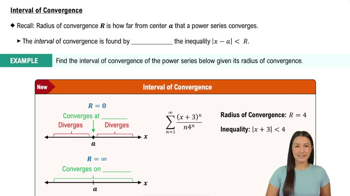
Interval of Convergence

The interval of convergence defines the range of x-values for which the infinite series converges to the function. It is found using tests like the ratio or root test. For ln(1+x), the series converges when -1 < x ≤ 1, ensuring the series sum accurately represents the function within this domain.
추천 영상:
08:44
Interval of Convergence

Evaluating Series at Specific Points

Substituting specific values of x into the Maclaurin series allows evaluation of infinite sums related to the function. For example, plugging x = -1/2 into the ln(1+x) series helps find the sum of ∑ₖ₌₁∞ 1/(k 2ᵏ). This technique connects function values to series sums, enabling exact or approximate calculations of infinite series.
추천 영상:
가이드 코스
06:00
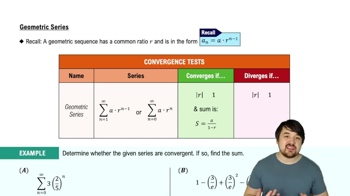
Geometric Series
관련 실천
교과서 질문

Approximating real numbers Use an appropriate Taylor series to find the first four nonzero terms of an infinite series that is equal to the following numbers.

cos 2

67
views

교과서 질문

Use of Tech Linear and quadratic approximation


a. Find the linear approximating polynomial for the following functions centered at the given point a.


b. Find the quadratic approximating polynomial for the following functions centered at a.


c Use the polynomials obtained in parts (a) and (b) to approximate the given quantity.


Find the Taylor polynomials p₁, p₂, and p₃ centered at a=1 for f(x)=x³.

55
views
교과서 질문

Combining power series Use the geometric series


f(x) = 1/(1-x) = ∑ₖ₌₀∞ xᵏ, for |x| < 1,


to find the power series representation for the following functions (centered at 0). Give the interval of convergence of the new series.


g(x) = x³/(1 − x)

76
views
교과서 질문

Differentiating and integrating power series Find the power series representation for g centered at 0 by differentiating or integrating the power series for f (perhaps more than once). Give the interval of convergence for the resulting series.


g(x) = 2/(1 − 2x)² using f(x) = 1/(1 − 2x)

84
views
교과서 질문

Radius of convergence Find the radius of convergence for the following power series.

∑ₖ₌₁∞ (k!xᵏ)/(kᵏ)

87
views
교과서 질문

Combining power series Use the power series representation


f(x ) =ln (1 − x) = −∑ₖ₌₁∞ xᵏ/k, for −1 ≤ x < 1,


to find the power series for the following functions (centered at 0). Give the interval of convergence of the new series.


p(x) = 2x⁶ ln(1 − x)

85
views