
교과서 질문
Taylor series and interval of convergence
a. Use the definition of a Taylor/Maclaurin series to find the first four nonzero terms of the Taylor series for the given function centered at a.
f(x)=3ˣ, a=0
88
views

 검증된 단계별 안내
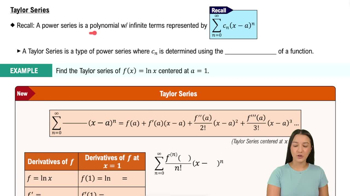
 08:42
08:42
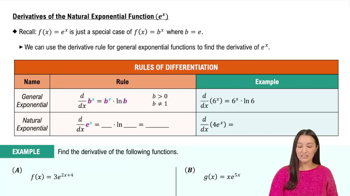 04:56
04:56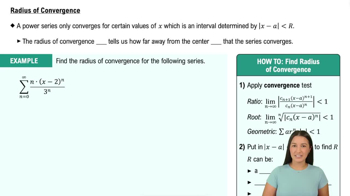 07:36
07:36Taylor series and interval of convergence
a. Use the definition of a Taylor/Maclaurin series to find the first four nonzero terms of the Taylor series for the given function centered at a.
f(x)=3ˣ, a=0
Taylor series and interval of convergence
a. Use the definition of a Taylor/Maclaurin series to find the first four nonzero terms of the Taylor series for the given function centered at a.
f(x) = tan ⁻¹ (x/2), a = 0
Matching functions with polynomials Match functions a–f with Taylor polynomials A–F (all centered at 0). Give reasons for your choices.
a. √(1 + 2x)
A. p₂(x)= 1 + 2x + 2x²
B. p₂(x) = 1 − 6x + 24x²
C. p₂(x) = 1 + x − x²/2
D. p₂(x) = 1 − 2x + 4x²
E. p₂(x) = 1 − x + (3/2)x²
F. p₂(x) = 1 − 2x + 2x²
Taylor series and interval of convergence
a. Use the definition of a Taylor/Maclaurin series to find the first four nonzero terms of the Taylor series for the given function centered at a.
f(x)=2/(1−x)³, a=0
Taylor series and interval of convergence
a. Use the definition of a Taylor/Maclaurin series to find the first four nonzero terms of the Taylor series for the given function centered at a.
f(x) = e⁻ˣ, a=0
{Use of Tech} Small argument approximations Consider the following common approximations when x is near zero.
a. Estimate f(0.1) and give a bound on the error in the approximation.
f(x) = eˣ ≈ 1 + x