Ch. 11 - Power Series
Briggs - Calculus: Early Transcendentals 3rd Edition
Briggs3rd EditionCalculus: Early TranscendentalsISBN: 9780136847243당신이 사용하는 게 아니라요?교과서 변경
11장, 문제 11.RE.26

Radius and interval of convergence Use the Ratio Test or the Root Test to determine the radius of convergence of the following power series. Test the endpoints to determine the interval of convergence, when appropriate.


x +x³/3 +x⁵/5 +x⁷/7 + ...

검증된 단계별 안내
1
Identify the general term of the power series. Notice the pattern in the series: the powers of \( x \) are odd numbers (1, 3, 5, 7, ...) and the denominators are the same odd numbers. So the general term can be written as \( a_n = \frac{x^{2n+1}}{2n+1} \) where \( n = 0, 1, 2, \ldots \).
Apply the Ratio Test to the general term to find the radius of convergence. The Ratio Test involves computing the limit \( L = \lim_{n \to \infty} \left| \frac{a_{n+1}}{a_n} \right| \). Substitute the general term expressions for \( a_{n+1} \) and \( a_n \) and simplify the expression.
Simplify the ratio inside the limit: \( \left| \frac{a_{n+1}}{a_n} \right| = \left| \frac{\frac{x^{2(n+1)+1}}{2(n+1)+1}}{\frac{x^{2n+1}}{2n+1}} \right| = \left| x^2 \right| \cdot \frac{2n+1}{2n+3} \). Then take the limit as \( n \to \infty \) to find \( L = |x|^2 \cdot 1 = |x|^2 \).
Use the Ratio Test criterion for convergence: the series converges if \( L < 1 \), which means \( |x|^2 < 1 \) or equivalently \( |x| < 1 \). This gives the radius of convergence \( R = 1 \).
Test the endpoints \( x = -1 \) and \( x = 1 \) by substituting them into the original series and checking for convergence. This typically involves recognizing the resulting series (e.g., alternating series or p-series) and applying appropriate convergence tests such as the Alternating Series Test or the p-series test.

비슷한 문제에 대한 검증된 영상 답변:

이 영상 해법은 위 문제에 도움이 된다고 튜터들이 추천한 것입니다.
영상 길이:
8m
도움이 되었나요?

주요 개념

질문에 올바르게 답하기 위해 반드시 이해해야 하는 핵심 개념들은 다음과 같습니다.

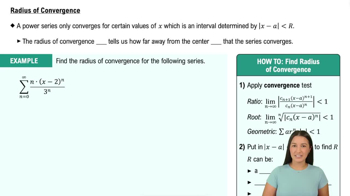
Radius of Convergence

The radius of convergence is the distance from the center of a power series within which the series converges absolutely. It defines the interval on the real line where the series sums to a finite value. Finding this radius helps determine where the power series represents a valid function.
추천 영상:
07:36
Radius of Convergence

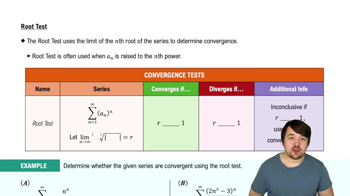
Ratio and Root Tests

The Ratio Test and Root Test are methods to determine the convergence of infinite series. The Ratio Test examines the limit of the ratio of successive terms, while the Root Test looks at the nth root of the absolute value of terms. Both tests help find the radius of convergence for power series.
추천 영상:

Testing Endpoints for Interval of Convergence

After finding the radius of convergence, the interval of convergence includes points within that radius. However, convergence at the endpoints must be checked separately, as the series may converge or diverge there. Testing endpoints ensures the full interval of convergence is accurately identified.
추천 영상:
가이드 코스
07:51
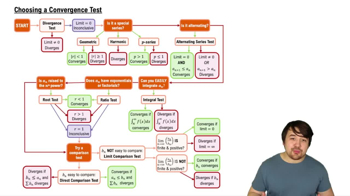
Choosing a Convergence Test
관련 실천
교과서 질문

Taylor polynomials Find the nth-order Taylor polynomial for the following functions centered at the given point a.

ƒ(x) = e^(sin x), n = 2, a = 0

62
views

교과서 질문

Radius and interval of convergence Use the Ratio Test or the Root Test to determine the radius of convergence of the following power series. Test the endpoints to determine the interval of convergence, when appropriate.


Σ (x - 1)ᵏ/(k5ᵏ)

k = 1

60
views
교과서 질문

Radius and interval of convergence Use the Ratio Test or the Root Test to determine the radius of convergence of the following power series. Test the endpoints to determine the interval of convergence, when appropriate.


Σ x⁴ᵏ/k²

k = 1

97
views
교과서 질문

Find the remainder term Rₙ(x) for the Taylor series centered at 0 for the following functions. Find an upper bound for the magnitude of the remainder on the given interval for the given value of n. (The bound is not unique.)


ƒ(x) = eˣ; bound R₃(x), for |x| < 1

39
views
교과서 질문

Find the remainder term Rₙ(x) for the Taylor series centered at 0 for the following functions. Find an upper bound for the magnitude of the remainder on the given interval for the given value of n. (The bound is not unique.)


ƒ(x) = ln (1 - x); bound R₃(x), for |x| < 1/2

57
views
교과서 질문

ƒ(x) = eˣ, a = 0; e-0.08


b. Use the Taylor polynomials to approximate the given expression. Make a table showing the approximations and the absolute error in these approximations using a calculator for the exact function value.

45
views