Ch. 11 - Power Series
Briggs - Calculus: Early Transcendentals 3rd Edition
Briggs3rd EditionCalculus: Early TranscendentalsISBN: 9780136847243당신이 사용하는 게 아니라요?교과서 변경
11장, 문제 11.3.23a

Taylor series and interval of convergence


a. Use the definition of a Taylor/Maclaurin series to find the first four nonzero terms of the Taylor series for the given function centered at a.


f(x) = cosh 3x, a = 0

검증된 단계별 안내
1
Recall the definition of the Maclaurin series for a function \(f(x)\) centered at \(a=0\): \[f(x) = \sum_{n=0}^{\infty} \frac{f^{(n)}(0)}{n!} x^n,\] where \(f^{(n)}(0)\) is the \(n\)-th derivative of \(f\) evaluated at 0.
Identify the function: \(f(x) = \cosh(3x)\). We will need to find the derivatives of \(f(x)\) and evaluate them at \(x=0\).
Compute the first few derivatives of \(f(x)\): - \(f(x) = \cosh(3x)\) - \(f'(x) = 3 \sinh(3x)\) - \(f''(x) = 9 \cosh(3x)\) - \(f^{(3)}(x) = 27 \sinh(3x)\) - \(f^{(4)}(x) = 81 \cosh(3x)\) and so on.
Evaluate these derivatives at \(x=0\): - \(f(0) = \cosh(0) = 1\) - \(f'(0) = 3 \sinh(0) = 0\) - \(f''(0) = 9 \cosh(0) = 9\) - \(f^{(3)}(0) = 27 \sinh(0) = 0\) - \(f^{(4)}(0) = 81 \cosh(0) = 81\)
Write the first four nonzero terms of the Maclaurin series using the formula: \[f(x) \approx \sum_{n=0}^{3} \frac{f^{(n)}(0)}{n!} x^n,\] but since odd derivatives are zero, only even terms contribute: \[f(x) \approx f(0) + \frac{f''(0)}{2!} x^2 + \frac{f^{(4)}(0)}{4!} x^4 + \ldots\] Substitute the values found to express these terms explicitly.

비슷한 문제에 대한 검증된 영상 답변:

이 영상 해법은 위 문제에 도움이 된다고 튜터들이 추천한 것입니다.
영상 길이:
5m

주요 개념

질문에 올바르게 답하기 위해 반드시 이해해야 하는 핵심 개념들은 다음과 같습니다.

Taylor and Maclaurin Series

A Taylor series represents a function as an infinite sum of terms calculated from the derivatives of the function at a single point. When centered at zero, it is called a Maclaurin series. Each term involves the nth derivative evaluated at the center, multiplied by (x - a)^n and divided by n!.
추천 영상:
08:26
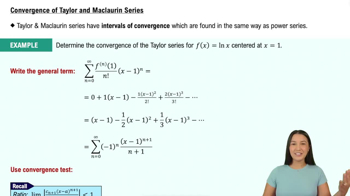
Convergence of Taylor & Maclaurin Series

Derivatives of Hyperbolic Functions

Understanding the derivatives of hyperbolic functions like cosh(x) is essential. For cosh(3x), derivatives alternate between cosh(3x) and sinh(3x), scaled by powers of 3 due to the chain rule. This pattern helps compute the terms of the Taylor series efficiently.
추천 영상:
가이드 코스
5:50
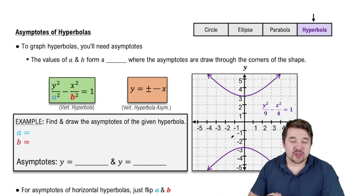
Asymptotes of Hyperbolas

Interval of Convergence

The interval of convergence is the range of x-values for which the Taylor series converges to the function. For entire functions like cosh(3x), the series converges for all real x, meaning the interval of convergence is (-∞, ∞). This ensures the series accurately represents the function everywhere.
추천 영상:
08:44
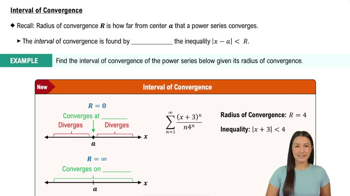
Interval of Convergence
관련 실천
교과서 질문

Sine integral function The function Si(x) = ∫₀ˣ f(t) dt, where f(t) = {(sin t)/t if t ≠ 0, 1 if t = 0, is called the sine integral function.

a. Expand the integrand in a Taylor series centered at 0.

121
views

교과서 질문

Probability: sudden−death playoff Teams A and B go into suddendeath overtime after playing to a tie. The teams alternate possession of the ball, and the first team to score wins. Assume each team has a 1/6 chance of scoring when it has the ball, and Team A has the ball first.


a. The probability that Team A ultimately wins is ∑ₖ₌₀∞ (1/6)(5/6)²ᵏ. Evaluate this series.

51
views
교과서 질문

Taylor series


a. Use the definition of a Taylor series to find the first four nonzero terms of the Taylor series for the given function centered at a.


f(x) = 1/x, a = 1

59
views
교과서 질문

Taylor series


a. Use the definition of a Taylor series to find the first four nonzero terms of the Taylor series for the given function centered at a.


f(x)=sin x, a = π/2

73
views
교과서 질문

{Use of Tech} Bessel functions Bessel functions arise in the study of wave propagation in circular geometries (for example, waves on a circular drum head). They are conveniently defined as power series. One of an infinite family of Bessel functions is

J₀(x) = ∑ₖ₌₀∞ (−1)ᵏ/(2²ᵏ(k!)²) x²ᵏ

a. Write out the first four terms of J₀.

61
views
교과서 질문

{Use of Tech} Fresnel integrals The theory of optics gives rise to the two Fresnel integrals

S(x) = ∫₀ˣ sin t² dt and C(x) = ∫₀ˣ cos t² dt

a. Compute S′(x) and C′(x).

95
views