Ch. 11 - Power Series
Briggs - Calculus: Early Transcendentals 3rd Edition
Briggs3rd EditionCalculus: Early TranscendentalsISBN: 9780136847243당신이 사용하는 게 아니라요?교과서 변경
11장, 문제 11.3.13c

Taylor series and interval of convergence


c. Determine the interval of convergence of the series.


f(x)=2/(1−x)³, a=0

검증된 단계별 안내
1
Recognize that the function given is \(f(x) = \frac{2}{(1 - x)^3}\), and we want to find the interval of convergence of its Taylor series centered at \(a = 0\).
Recall that the Taylor series for \(\frac{1}{(1 - x)^n}\), where \(n\) is a positive integer, can be expressed using the generalized binomial series or by differentiating the geometric series multiple times.
Since \(f(x) = 2 \cdot \frac{1}{(1 - x)^3}\), start from the geometric series \(\frac{1}{1 - x} = \sum_{k=0}^\infty x^k\) which converges for \(|x| < 1\), and differentiate it twice to get the series for \(\frac{1}{(1 - x)^3}\).
Use the fact that differentiation of a power series term-by-term preserves the radius of convergence, so the radius of convergence remains \(1\) after differentiations.
Conclude that the interval of convergence for the Taylor series of \(f(x)\) centered at \(0\) is \((-1, 1)\), but check the endpoints \(x = -1\) and \(x = 1\) separately by substituting into the series to determine if the series converges or diverges at these points.

비슷한 문제에 대한 검증된 영상 답변:

이 영상 해법은 위 문제에 도움이 된다고 튜터들이 추천한 것입니다.
영상 길이:
5m
도움이 되었나요?

주요 개념

질문에 올바르게 답하기 위해 반드시 이해해야 하는 핵심 개념들은 다음과 같습니다.

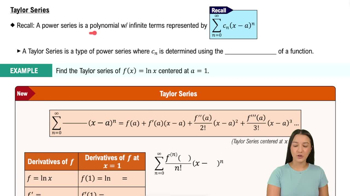
Taylor Series Expansion

A Taylor series represents a function as an infinite sum of terms calculated from the derivatives of the function at a single point. For f(x) centered at a=0, the series uses derivatives evaluated at 0 to approximate f(x) near that point. Understanding how to find the general term is essential for expressing the function as a power series.
추천 영상:
08:42
Taylor Series

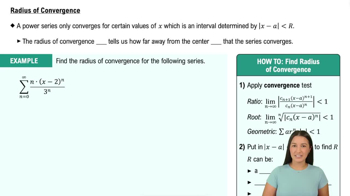
Radius and Interval of Convergence

The radius of convergence defines the distance from the center within which the Taylor series converges to the function. The interval of convergence includes all x-values where the series converges, possibly including endpoints. Determining this interval often involves applying convergence tests like the ratio or root test.
추천 영상:
07:36
Radius of Convergence

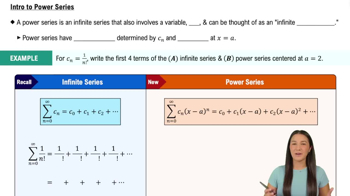
Convergence Tests for Power Series

Tests such as the ratio test or root test help determine whether a power series converges for specific values of x. These tests analyze the limit of the ratio or nth root of successive terms to find the radius of convergence. Applying these tests is crucial to identify the interval where the Taylor series accurately represents the function.
추천 영상:
05:58
Intro to Power Series
관련 실천
교과서 질문

Explain why or why not Determine whether the following statements are true and give an explanation or counterexample.


c. Only even powers of x appear in the nth−order Taylor polynomial for f(x)=√(1+x²) centered at 0.

59
views

교과서 질문

Explain why or why not Determine whether the following statements are true and give an explanation or counterexample.

c. If f has a Taylor series that converges only on (−2,2), then f(x²) has a Taylor series that also converges only on (−2,2).

60
views
교과서 질문

Explain why or why not Determine whether the following statements are true and give an explanation or counterexample.

d. Suppose f'' is continuous on an interval that contains a, where f has an inflection point at a. Then the second−order Taylor polynomial for f at a is linear.

49
views
교과서 질문

{Use of Tech} Bessel functions Bessel functions arise in the study of wave propagation in circular geometries (for example, waves on a circular drum head). They are conveniently defined as power series. One of an infinite family of Bessel functions is

J₀(x) = ∑ₖ₌₀∞ (−1)ᵏ/(2²ᵏ(k!)²) x²ᵏ

c. Differentiate J₀ twice and show (by keeping terms through x⁶) that J₀ satisfies the equation x² y′′(x) + xy′(x) + x²y(x)=0.

54
views
교과서 질문

{Use of Tech} Fresnel integrals The theory of optics gives rise to the two Fresnel integrals

S(x) = ∫₀ˣ sin t² dt and C(x) = ∫₀ˣ cos t² dt

c. Use the polynomials in part (b) to approximate S(0.05) and C(−0.25).

93
views
교과서 질문

Matching functions with polynomials Match functions a–f with Taylor polynomials A–F (all centered at 0). Give reasons for your choices.


d. 1/(1 + 2x)


A. p₂(x)= 1 + 2x + 2x²

B. p₂(x) = 1 − 6x + 24x²

C. p₂(x) = 1 + x − x²/2

D. p₂(x) = 1 − 2x + 4x²

E. p₂(x) = 1 − x + (3/2)x²

F. p₂(x) = 1 − 2x + 2x²

30
views