
교과서 질문
Use the Taylor series for cos x centered at 0 to verify that lim ₓ→ₐ (1− cos x)/x = 0.
119
views

 검증된 단계별 안내
 07:00
07:00
 04:57
04:57 5:10
5:10Use the Taylor series for cos x centered at 0 to verify that lim ₓ→ₐ (1− cos x)/x = 0.
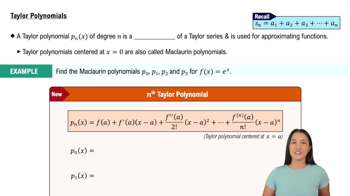
{Use of Tech} Approximations with Taylor polynomials
a. Approximate the given quantities using Taylor polynomials with n = 3.
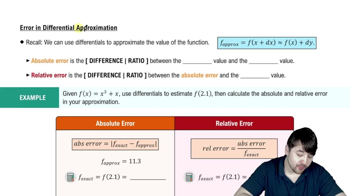
b. Compute the absolute error in the approximation, assuming the exact value is given by a calculator.
e⁰ᐧ¹²
Suppose a power series converges if |x−3|<4 and diverges if |x−3| ≥ 4. Determine the radius and interval of convergence.
Differentiating and integrating power series Find the power series representation for g centered at 0 by differentiating or integrating the power series for f (perhaps more than once). Give the interval of convergence for the resulting series.
g(x) = − 1/(1 + x)² using f(x) = 1/(1 + x)
Limits Evaluate the following limits using Taylor series.
lim ₓ→₀ (sin 2x)/x
Radius and interval of convergence Determine the radius and interval of convergence of the following power series.
∑ₖ₌₀∞ (x/3)ᵏ