Ch. 11 - Power Series
Briggs - Calculus: Early Transcendentals 3rd Edition
Briggs3rd EditionCalculus: Early TranscendentalsISBN: 9780136847243당신이 사용하는 게 아니라요?교과서 변경
11장, 문제 11.1.62

{Use of Tech} Number of terms What is the minimum order of the Taylor polynomial required to approximate the following quantities with an absolute error no greater than 10⁻³ ? (The answer depends on your choice of a center.)
ln 0.85

검증된 단계별 안내
1
Identify the function to approximate: here, it is \( f(x) = \ln(x) \). We want to approximate \( \ln(0.85) \) using a Taylor polynomial centered at some point \( a \).
Choose a center \( a \) close to 0.85 to ensure faster convergence and smaller error. A common choice is \( a = 1 \) because \( \ln(1) = 0 \) and derivatives of \( \ln(x) \) at 1 are easy to compute.
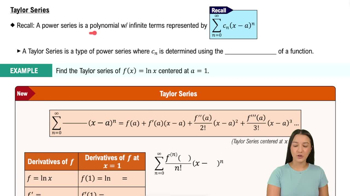
Write the Taylor series expansion of \( \ln(x) \) about \( a = 1 \): \[ \ln(x) = \ln(1) + \sum_{n=1}^{\infty} \frac{f^{(n)}(1)}{n!} (x - 1)^n \] where \( f^{(n)}(x) \) denotes the \( n \)-th derivative of \( \ln(x) \).
Determine the general form of the \( n \)-th derivative of \( \ln(x) \) at \( x=1 \) and write the Taylor polynomial of order \( N \) as: \[ P_N(x) = \sum_{n=1}^N \frac{(-1)^{n-1} (n-1)!}{n!} (x - 1)^n = \sum_{n=1}^N (-1)^{n-1} \frac{(x-1)^n}{n} \] (since the derivatives of \( \ln(x) \) at 1 follow a known pattern).
Use the Lagrange remainder formula to bound the absolute error: \[ |R_{N}(x)| = \left| \frac{f^{(N+1)}(c)}{(N+1)!} (x - 1)^{N+1} \right| \leq 10^{-3} \] where \( c \) is some number between \( x = 0.85 \) and \( a = 1 \). Find the smallest \( N \) such that this inequality holds.

비슷한 문제에 대한 검증된 영상 답변:

이 영상 해법은 위 문제에 도움이 된다고 튜터들이 추천한 것입니다.
영상 길이:
4m

주요 개념

질문에 올바르게 답하기 위해 반드시 이해해야 하는 핵심 개념들은 다음과 같습니다.

Taylor Polynomial Approximation

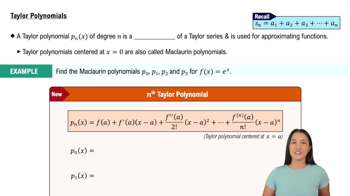
A Taylor polynomial approximates a function near a chosen center point using a finite sum of derivatives at that point. The degree (order) of the polynomial determines the accuracy of the approximation, with higher orders generally yielding better precision within a certain interval.
추천 영상:
07:00
Taylor Polynomials

Error Bound for Taylor Polynomials

The error bound estimates the difference between the actual function value and its Taylor polynomial approximation. It is often expressed using the remainder term, which depends on the next derivative and the distance from the center, helping to determine the minimum polynomial order needed for a desired accuracy.
추천 영상:
07:00
Taylor Polynomials

Choice of Center in Taylor Series

The center (or expansion point) of a Taylor series affects convergence and error size. Choosing a center close to the point of evaluation reduces the distance in the remainder term, often lowering the required polynomial order to achieve a specific error tolerance.
추천 영상:
08:42
Taylor Series