
Ch. 11 - Power Series
Briggs - Calculus: Early Transcendentals 3rd Edition
Briggs3rd EditionCalculus: Early TranscendentalsISBN: 9780136847243당신이 사용하는 게 아니라요?교과서 변경
11장, 문제 11.RE.11a

ƒ(x) = eˣ, a = 0; e-0.08


a. Find the Taylor polynomials of order n = 1 and n = 2 for the given functions centered at the given point a.

검증된 단계별 안내
1
Identify the function and the center point: here, the function is \(f(x) = e^{x}\) and the center point is \(a = 0\).
Recall the general formula for the Taylor polynomial of order \(n\) centered at \(a\): \[T_n(x) = \sum_{k=0}^n \frac{f^{(k)}(a)}{k!} (x - a)^k,\] where \(f^{(k)}(a)\) is the \(k\)-th derivative of \(f\) evaluated at \(a\).
Calculate the derivatives of \(f(x) = e^{x}\) and evaluate them at \(a=0\): - \(f(x) = e^{x}\), so \(f(0) = e^{0} = 1\), - \(f'(x) = e^{x}\), so \(f'(0) = 1\), - \(f''(x) = e^{x}\), so \(f''(0) = 1\).
Write the Taylor polynomial of order \(n=1\) using the formula: \[T_1(x) = f(0) + f'(0)(x - 0) = 1 + 1 \cdot x = 1 + x.\]
Write the Taylor polynomial of order \(n=2\) using the formula: \[T_2(x) = f(0) + f'(0)(x - 0) + \frac{f''(0)}{2!}(x - 0)^2 = 1 + x + \frac{1}{2} x^2.\]

비슷한 문제에 대한 검증된 영상 답변:

이 영상 해법은 위 문제에 도움이 된다고 튜터들이 추천한 것입니다.
영상 길이:
2m
도움이 되었나요?

주요 개념

질문에 올바르게 답하기 위해 반드시 이해해야 하는 핵심 개념들은 다음과 같습니다.

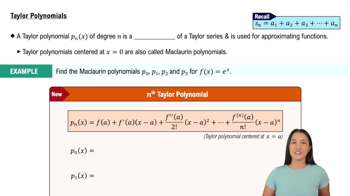
Taylor Polynomials

Taylor polynomials approximate a function near a point using a finite sum of its derivatives at that point. The nth-order Taylor polynomial includes terms up to the nth derivative, providing increasingly accurate approximations as n increases.
추천 영상:
07:00
Taylor Polynomials

Derivatives of Exponential Functions

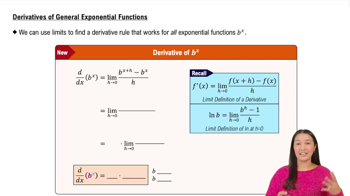
The function f(x) = e^x has the unique property that all its derivatives are equal to e^x. This simplifies finding Taylor polynomials since each derivative evaluated at a point a is e^a, making the polynomial terms straightforward to compute.
추천 영상:
04:50
Derivatives of General Exponential Functions

Centering the Polynomial at a Point

Centering a Taylor polynomial at a point a means the polynomial approximates the function near x = a. The polynomial uses (x - a) as the variable, ensuring the approximation is most accurate close to this center.
추천 영상:
07:00
Taylor Polynomials
관련 실천
교과서 질문

Radius and interval of convergence Use the Ratio Test or the Root Test to determine the radius of convergence of the following power series. Test the endpoints to determine the interval of convergence, when appropriate.


Σ (x - 1)ᵏ/(k5ᵏ)

k = 1

60
views
교과서 질문

Matching functions with polynomials Match functions a–f with Taylor polynomials A–F (all centered at 0). Give reasons for your choices.


a. √(1 + 2x)


A. p₂(x)= 1 + 2x + 2x²

B. p₂(x) = 1 − 6x + 24x²

C. p₂(x) = 1 + x − x²/2

D. p₂(x) = 1 − 2x + 4x²

E. p₂(x) = 1 − x + (3/2)x²

F. p₂(x) = 1 − 2x + 2x²

29
views
교과서 질문

Find the remainder term Rₙ(x) for the Taylor series centered at 0 for the following functions. Find an upper bound for the magnitude of the remainder on the given interval for the given value of n. (The bound is not unique.)


ƒ(x) = ln (1 - x); bound R₃(x), for |x| < 1/2

57
views
교과서 질문

Radius and interval of convergence Use the Ratio Test or the Root Test to determine the radius of convergence of the following power series. Test the endpoints to determine the interval of convergence, when appropriate.


Σ (x/9)³ᵏ

k = 0

91
views
교과서 질문

Taylor series and interval of convergence


a. Use the definition of a Taylor/Maclaurin series to find the first four nonzero terms of the Taylor series for the given function centered at a.


f(x)=2/(1−x)³, a=0

82
views
교과서 질문

Taylor series


a. Use the definition of a Taylor series to find the first four nonzero terms of the Taylor series for the given function centered at a.


f(x) = 2ˣ, a = 1

70
views