Ch. 2 - Limits
Briggs - Calculus: Early Transcendentals 3rd Edition
Briggs3rd EditionCalculus: Early TranscendentalsISBN: 9780136847243당신이 사용하는 게 아니라요?교과서 변경
2장, 문제 70a

Analyze lim x→∞ f(x) and lim x→−∞ f(x), and then identify any horizontal asymptotes.
f(x) = (x2 − 4x + 3) / (x − 1)

검증된 단계별 안내
1
Step 1: Identify the degrees of the polynomial in the numerator and the denominator. The numerator is a quadratic polynomial \(x^2 - 4x + 3\) with degree 2, and the denominator is a linear polynomial \(x - 1\) with degree 1.
Step 2: Since the degree of the numerator (2) is greater than the degree of the denominator (1), the limits \(\lim_{x \to \infty} f(x)\) and \(\lim_{x \to -\infty} f(x)\) will both tend towards infinity or negative infinity, indicating that there are no horizontal asymptotes.
Step 3: To further analyze the behavior of \(f(x)\) as \(x\) approaches infinity or negative infinity, perform polynomial long division on \(x^2 - 4x + 3\) by \(x - 1\).
Step 4: The result of the division will be a linear expression plus a remainder over \(x - 1\). This linear expression will dominate the behavior of \(f(x)\) as \(x\) approaches infinity or negative infinity.
Step 5: Conclude that since the degree of the numerator is greater than the degree of the denominator, \(f(x)\) does not have horizontal asymptotes, but it may have an oblique (slant) asymptote, which is the linear expression obtained from the division.

비슷한 문제에 대한 검증된 영상 답변:

이 영상 해법은 위 문제에 도움이 된다고 튜터들이 추천한 것입니다.
영상 길이:
4m
도움이 되었나요?

주요 개념

질문에 올바르게 답하기 위해 반드시 이해해야 하는 핵심 개념들은 다음과 같습니다.

Limits at Infinity

Limits at infinity involve evaluating the behavior of a function as the input approaches positive or negative infinity. This analysis helps determine how the function behaves for very large or very small values of x, which is crucial for identifying horizontal asymptotes.
추천 영상:
05:50
One-Sided Limits

Horizontal Asymptotes

Horizontal asymptotes are lines that a graph approaches as x approaches infinity or negative infinity. They indicate the value that the function approaches, providing insight into its long-term behavior. A function can have one or two horizontal asymptotes depending on its limits at both infinities.
추천 영상:
5:46
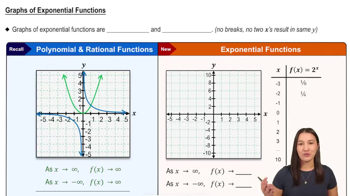
Graphs of Exponential Functions

Polynomial Division

Polynomial division is a method used to simplify rational functions by dividing the numerator by the denominator. This technique is particularly useful for finding limits at infinity, as it allows us to identify the leading terms that dominate the behavior of the function as x becomes very large or very small.
추천 영상:
6:04
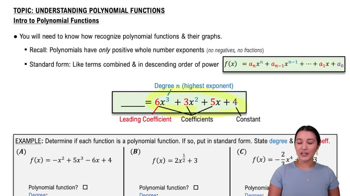
Introduction to Polynomial Functions