Ch. 2 - Limits
Briggs - Calculus: Early Transcendentals 3rd Edition
Briggs3rd EditionCalculus: Early TranscendentalsISBN: 9780136847243당신이 사용하는 게 아니라요?교과서 변경
2장, 문제 81a

Analyze lim x→∞ f(x) and lim x→−∞ f(x), and then identify any horizontal asymptotes.


f(x)=cos x+2√x / √x.

검증된 단계별 안내
1
Step 1: Simplify the function f(x) = \(\frac{\cos x + 2\sqrt{x}\)}{\(\sqrt{x}\)}.
Step 2: Divide each term in the numerator by \(\sqrt{x}\) to get f(x) = \(\frac{\cos x}{\sqrt{x}\)} + 2.
Step 3: Analyze \(\lim\)_{x \(\to\) \(\infty\)} f(x). As x approaches infinity, \(\frac{\cos x}{\sqrt{x}\)} approaches 0 because \(\cos\) x is bounded between -1 and 1, while \(\sqrt{x}\) grows without bound.
Step 4: Therefore, \(\lim\)_{x \(\to\) \(\infty\)} f(x) = 0 + 2 = 2, indicating a horizontal asymptote at y = 2 as x approaches infinity.
Step 5: Analyze \(\lim\)_{x \(\to\) -\(\infty\)} f(x). Since \(\sqrt{x}\) is not defined for negative x, the limit as x approaches negative infinity does not exist, and there is no horizontal asymptote in this direction.

비슷한 문제에 대한 검증된 영상 답변:

이 영상 해법은 위 문제에 도움이 된다고 튜터들이 추천한 것입니다.
영상 길이:
3m
도움이 되었나요?

주요 개념

질문에 올바르게 답하기 위해 반드시 이해해야 하는 핵심 개념들은 다음과 같습니다.

Limits at Infinity

Limits at infinity involve evaluating the behavior of a function as the input approaches positive or negative infinity. This analysis helps determine the end behavior of the function, which is crucial for identifying horizontal asymptotes. For example, if the limit of f(x) as x approaches infinity exists and is a finite number, it indicates a horizontal asymptote at that value.
추천 영상:
05:50
One-Sided Limits

Horizontal Asymptotes

Horizontal asymptotes are lines that a graph approaches as x approaches infinity or negative infinity. They represent the value that the function approaches but may never actually reach. To find horizontal asymptotes, one typically evaluates the limits of the function at both ends of the x-axis, determining if the function stabilizes at a particular value.
추천 영상:
5:46
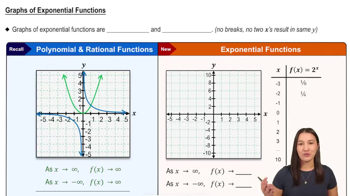
Graphs of Exponential Functions

Rational Functions and Simplification

Rational functions are ratios of polynomials, and their behavior at infinity can often be simplified by dividing the numerator and denominator by the highest power of x present. In the given function, simplifying helps to clearly see how the function behaves as x approaches infinity or negative infinity, which is essential for accurately determining limits and asymptotes.
추천 영상:
6:04
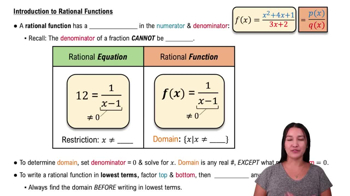
Intro to Rational Functions