Ch. 2 - Limits
Briggs - Calculus: Early Transcendentals 3rd Edition
Briggs3rd EditionCalculus: Early TranscendentalsISBN: 9780136847243당신이 사용하는 게 아니라요?교과서 변경
2장, 문제 2.13

Determine the following limits at infinity.


lim t→∞ et,lim t→−∞ e^t,and lim t→∞ e^−t

검증된 단계별 안내
1
Consider the function \(e^t\). As \(t\) approaches infinity, \(e^t\) grows exponentially without bound. Therefore, \(\lim_{t \to \infty} e^t = \infty\).
Now, consider the function \(e^t\) as \(t\) approaches negative infinity. As \(t\) becomes more negative, \(e^t\) approaches zero because the exponential function decays rapidly. Therefore, \(\lim_{t \to -\infty} e^t = 0\).
Next, consider the function \(e^{-t}\) as \(t\) approaches infinity. Notice that \(e^{-t} = \frac{1}{e^t}\). As \(t\) becomes very large, \(e^t\) becomes very large, making \(\frac{1}{e^t}\) approach zero. Therefore, \(\lim_{t \to \infty} e^{-t} = 0\).

비슷한 문제에 대한 검증된 영상 답변:

이 영상 해법은 위 문제에 도움이 된다고 튜터들이 추천한 것입니다.
영상 길이:
5m
도움이 되었나요?

주요 개념

질문에 올바르게 답하기 위해 반드시 이해해야 하는 핵심 개념들은 다음과 같습니다.

Limits at Infinity

Limits at infinity refer to the behavior of a function as the input approaches positive or negative infinity. Understanding these limits helps determine the end behavior of functions, which is crucial in calculus for analyzing asymptotic behavior and graphing functions.
추천 영상:
05:50
One-Sided Limits

Exponential Functions

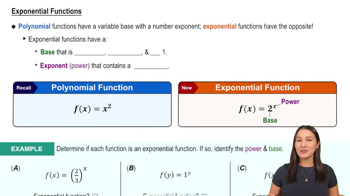
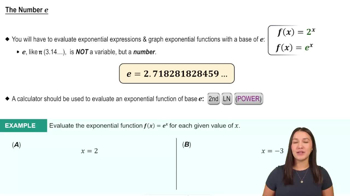
Exponential functions, such as e^t, are functions of the form f(t) = a^t, where 'a' is a positive constant. The base 'e' (approximately 2.718) is particularly important in calculus due to its unique properties, including its derivative being equal to the function itself, which simplifies many calculations involving growth and decay.
추천 영상:
6:13
Exponential Functions

Behavior of e^t and e^−t

The function e^t grows rapidly as t approaches infinity, leading to a limit of infinity. Conversely, e^−t approaches zero as t approaches infinity, indicating decay. Understanding these behaviors is essential for evaluating the specified limits and interpreting their implications in various contexts.
추천 영상:
4:47
The Number e
관련 실천
교과서 질문

If a function f represents a system that varies in time, the existence of lim limtf(t){\(\displaystyle\[\lim\)_{t\(\rightarrow\]\infty\)}{f(t)}} means that the system reaches a steady state (or equilibrium). For the following systems, determine whether a steady state exists and give the steady-state value.


The population of a culture of tumor cells is given by p(t)=3500tt+1p\(\left\)(t\(\right\))=\(\frac{3500t}{t+1}\).

373
views
교과서 질문

If a function f represents a system that varies in time, the existence of lim limtf(t){\(\displaystyle\[\lim\)_{t\(\rightarrow\]\infty\)}{f(t)}} means that the system reaches a steady state (or equilibrium). For the following systems, determine whether a steady state exists and give the steady-state value.


The population of a colony of squirrels is given by p(t)=15003+2e0.1tp\(\left\)(t\(\right\))=\(\frac{1500}{3+2e^{-0.1t}\)}.

366
views
교과서 질문

Determine limxf(x)\(\lim\)_{x\(\rightarrow\]\infty\)}f\(\left\)(x\(\right\)) and limxf(x)\(\lim\)_{x\(\rightarrow\)-\(\infty\)}f\(\left\)(x\(\right\)) for the following functions. Then give the horizontal asymptotes of ff (if any).


f(x)=40x5+x216x42xf\(\left\)(x\(\right\))=\(\frac{40x^5+x^2}{16x^4-2x}\)

367
views
교과서 질문

Use analytical methods and/or a graphing utility to identify the vertical asymptotes (if any) of the following functions.

h(x)=e^x(x+1)^3

299
views
교과서 질문

Evaluate each limit and justify your answer. 

lim x→1 (x+5x / x+2)^4

369
views
교과서 질문

Find polynomials p and q such that f=p/q is undefined at 1 and 2, but f has a vertical asymptote only at 2. Sketch a graph of your function.

377
views