Ch. 2 - Limits
Briggs - Calculus: Early Transcendentals 3rd Edition
Briggs3rd EditionCalculus: Early TranscendentalsISBN: 9780136847243당신이 사용하는 게 아니라요?교과서 변경
2장, 문제 24c

Determine the following limits.


c. lim x→1 x / |x − 1|

검증된 단계별 안내
1
Step 1: Understand the nature of the absolute value function. The expression |x - 1| represents the distance of x from 1 on the number line. It is defined as |x - 1| = x - 1 if x >= 1 and |x - 1| = -(x - 1) if x < 1.
Step 2: Consider the limit from the right (x approaches 1 from values greater than 1). In this case, |x - 1| = x - 1, so the expression becomes x / (x - 1).
Step 3: Evaluate the limit from the right. As x approaches 1 from the right, the denominator (x - 1) approaches 0, causing the expression x / (x - 1) to approach infinity. Therefore, the right-hand limit is positive infinity.
Step 4: Consider the limit from the left (x approaches 1 from values less than 1). In this case, |x - 1| = -(x - 1), so the expression becomes x / (-(x - 1)) = -x / (x - 1).
Step 5: Evaluate the limit from the left. As x approaches 1 from the left, the denominator (x - 1) approaches 0, causing the expression -x / (x - 1) to approach negative infinity. Therefore, the left-hand limit is negative infinity.

비슷한 문제에 대한 검증된 영상 답변:

이 영상 해법은 위 문제에 도움이 된다고 튜터들이 추천한 것입니다.
영상 길이:
2m
도움이 되었나요?

주요 개념

질문에 올바르게 답하기 위해 반드시 이해해야 하는 핵심 개념들은 다음과 같습니다.

Limits

A limit is a fundamental concept in calculus that describes the behavior of a function as its input approaches a certain value. It helps in understanding how functions behave near points of interest, including points of discontinuity or infinity. Evaluating limits is essential for defining derivatives and integrals, which are core components of calculus.
추천 영상:
05:50
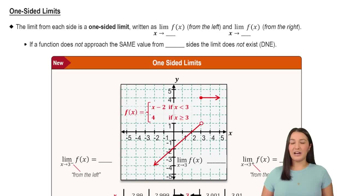
One-Sided Limits

Absolute Value Function

The absolute value function, denoted as |x|, measures the distance of a number from zero on the number line, always yielding a non-negative result. In the context of limits, the absolute value can affect the behavior of a function as it approaches a point, particularly when the function crosses zero, leading to different left-hand and right-hand limits.
추천 영상:
가이드 코스
05:03
Initial Value Problems

One-Sided Limits

One-sided limits refer to the value that a function approaches as the input approaches a specific point from one side only, either the left (denoted as lim x→c-) or the right (denoted as lim x→c+). In the given limit problem, evaluating one-sided limits is crucial because the absolute value function creates a piecewise scenario that can lead to different outcomes depending on the direction of approach.
추천 영상:
05:50
One-Sided Limits