Ch. 2 - Limits
Briggs - Calculus: Early Transcendentals 3rd Edition
Briggs3rd EditionCalculus: Early TranscendentalsISBN: 9780136847243당신이 사용하는 게 아니라요?교과서 변경
2장, 문제 2.30

Determine the following limits.


lim u→0^+ u − 1 / sin u

검증된 단계별 안내
1
Identify the limit expression: \( \lim_{{u \to 0^+}} \frac{u - 1}{\sin u} \).
Recognize that direct substitution of \( u = 0 \) results in an indeterminate form \( \frac{-1}{0} \), which suggests the need for further analysis.
Consider using L'Hôpital's Rule, which applies to limits of the form \( \frac{0}{0} \) or \( \frac{\infty}{\infty} \). However, since this is not directly applicable here, explore other methods.
Analyze the behavior of \( \sin u \) as \( u \to 0^+ \). Recall that \( \sin u \approx u \) for small \( u \), which can help simplify the expression.
Rewrite the limit using the approximation: \( \lim_{{u \to 0^+}} \frac{u - 1}{u} \) and evaluate this new expression to find the limit.

비슷한 문제에 대한 검증된 영상 답변:

이 영상 해법은 위 문제에 도움이 된다고 튜터들이 추천한 것입니다.
영상 길이:
1m
도움이 되었나요?

주요 개념

질문에 올바르게 답하기 위해 반드시 이해해야 하는 핵심 개념들은 다음과 같습니다.

Limits

Limits are fundamental concepts in calculus that describe the behavior of a function as its input approaches a certain value. They help in understanding the function's behavior near points of interest, including points of discontinuity or infinity. In this case, we are interested in the limit as u approaches 0 from the positive side, which is crucial for evaluating the expression given.
추천 영상:
05:50
One-Sided Limits

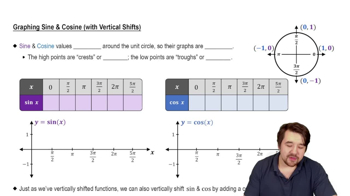
Sine Function

The sine function, denoted as sin(u), is a periodic function that oscillates between -1 and 1. It is essential in calculus for analyzing limits, especially when dealing with small angles. As u approaches 0, sin(u) can be approximated by its Taylor series expansion, which is useful for simplifying expressions involving limits.
추천 영상:
5:53
Graph of Sine and Cosine Function

L'Hôpital's Rule

L'Hôpital's Rule is a method used to evaluate limits that result in indeterminate forms, such as 0/0 or ∞/∞. It states that if the limit of f(u)/g(u) results in an indeterminate form, the limit can be found by taking the derivative of the numerator and the derivative of the denominator. This rule is particularly useful in the given limit problem, where direct substitution leads to an indeterminate form.
추천 영상: