


Ch. 2 - Limits
Briggs - Calculus: Early Transcendentals 3rd Edition
Briggs3rd EditionCalculus: Early TranscendentalsISBN: 9780136847243당신이 사용하는 게 아니라요?교과서 변경
2장, 문제 2.R.49

Determine the following limits.
lim x→∞ (5 + (cos4 x) / (x2 + x + 1))

검증된 단계별 안내
1
Identify the dominant term in the expression as \(x\) approaches infinity. The term \(5\) is constant, and the fraction \(\frac{\cos^4 x}{x^2 + x + 1}\) will determine the behavior of the limit.
Recognize that \(\cos^4 x\) is bounded between 0 and 1, since \(\cos x\) is bounded between -1 and 1.
Consider the denominator \(x^2 + x + 1\), which grows without bound as \(x\) approaches infinity.
Since the numerator \(\cos^4 x\) is bounded and the denominator \(x^2 + x + 1\) grows indefinitely, the fraction \(\frac{\cos^4 x}{x^2 + x + 1}\) approaches 0 as \(x\) approaches infinity.
Conclude that the limit is determined by the constant term, so \(\lim_{x \to \infty} \left(5 + \frac{\cos^4 x}{x^2 + x + 1}\right) = 5\).

비슷한 문제에 대한 검증된 영상 답변:

이 영상 해법은 위 문제에 도움이 된다고 튜터들이 추천한 것입니다.
영상 길이:
4m
도움이 되었나요?

주요 개념

질문에 올바르게 답하기 위해 반드시 이해해야 하는 핵심 개념들은 다음과 같습니다.

Limits at Infinity

Limits at infinity involve evaluating the behavior of a function as the input approaches infinity. In this context, we analyze how the function behaves when x becomes very large, which often simplifies the expression by focusing on the dominant terms.
추천 영상:
05:50
One-Sided Limits

Behavior of Trigonometric Functions

Trigonometric functions, such as cosine, oscillate between fixed values. In this limit problem, cos<sup>4</sup>(x) will always yield values between 0 and 1, which is crucial for determining the limit as x approaches infinity.
추천 영상:
6:04
Introduction to Trigonometric Functions

Polynomial Growth

In calculus, polynomial growth refers to how polynomial functions behave as their variable approaches infinity. In this limit, the denominator x<sup>2</sup> + x + 1 grows significantly larger than the numerator, influencing the overall limit of the expression.
추천 영상:
6:04
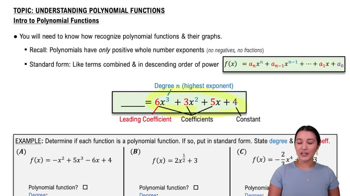
Introduction to Polynomial Functions