Ch. 2 - Limits
Briggs - Calculus: Early Transcendentals 3rd Edition
Briggs3rd EditionCalculus: Early TranscendentalsISBN: 9780136847243당신이 사용하는 게 아니라요?교과서 변경
2장, 문제 51

Determine the following limits.
lim x→1^− x/ ln x

검증된 단계별 안내
1
Identify the type of limit: This is a one-sided limit as \( x \to 1^- \), meaning we approach 1 from the left.
Substitute \( x = 1 \) into the expression \( \frac{x}{\ln x} \) to check if it results in an indeterminate form.
Recognize that as \( x \to 1^- \), \( \ln x \to \ln(1) = 0 \) and \( x \to 1 \), leading to the indeterminate form \( \frac{1}{0} \).
Apply L'Hôpital's Rule, which is used to evaluate limits of indeterminate forms like \( \frac{0}{0} \) or \( \frac{\infty}{\infty} \). Differentiate the numerator and the denominator separately.
Differentiate: The derivative of the numerator \( x \) is 1, and the derivative of the denominator \( \ln x \) is \( \frac{1}{x} \). Rewrite the limit as \( \lim_{x \to 1^-} \frac{1}{\frac{1}{x}} \).

비슷한 문제에 대한 검증된 영상 답변:

이 영상 해법은 위 문제에 도움이 된다고 튜터들이 추천한 것입니다.
영상 길이:
2m
도움이 되었나요?

주요 개념

질문에 올바르게 답하기 위해 반드시 이해해야 하는 핵심 개념들은 다음과 같습니다.

Limits

Limits are fundamental concepts in calculus that describe the behavior of a function as its input approaches a certain value. They help in understanding the function's behavior near points of interest, including points of discontinuity or infinity. In this case, we are interested in the limit as x approaches 1 from the left, which requires analyzing the function's values as they get closer to this point.
추천 영상:
05:50
One-Sided Limits

Natural Logarithm (ln)

The natural logarithm, denoted as ln(x), is the logarithm to the base e, where e is approximately 2.71828. It is a crucial function in calculus, particularly in limits and derivatives, as it has unique properties, such as being undefined for non-positive values. Understanding how ln(x) behaves as x approaches 1 is essential for evaluating the limit in the given question.
추천 영상:
05:18
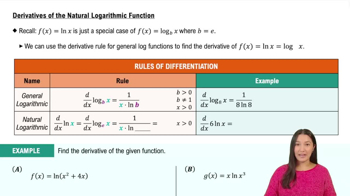
Derivative of the Natural Logarithmic Function

Indeterminate Forms

Indeterminate forms occur in calculus when evaluating limits leads to expressions like 0/0 or ∞/∞, which do not provide clear information about the limit's value. In the limit lim x→1^− x/ln x, both the numerator and denominator approach 0 as x approaches 1 from the left, creating an indeterminate form. Recognizing this allows us to apply techniques such as L'Hôpital's Rule to resolve the limit.
추천 영상:
3:56
Slope-Intercept Form