Ch. 2 - Limits
Briggs - Calculus: Early Transcendentals 3rd Edition
Briggs3rd EditionCalculus: Early TranscendentalsISBN: 9780136847243당신이 사용하는 게 아니라요?교과서 변경
2장, 문제 2.23c

For the following position functions, make a table of average velocities similar to those in Exercises 19–20 and make a conjecture about the instantaneous velocity at the indicated time. 


c. s(t)=40 sin 2t at t=0

검증된 단계별 안내
1
Step 1: Understand the problem. We need to find the average velocities of the function \( s(t) = 40 \sin(2t) \) around \( t = 0 \) and make a conjecture about the instantaneous velocity at \( t = 0 \).
Step 2: Recall that the average velocity over an interval \([a, b]\) is given by \( \frac{s(b) - s(a)}{b - a} \). Here, we will calculate this for intervals around \( t = 0 \).
Step 3: Choose intervals around \( t = 0 \), such as \([-0.1, 0.1]\), \([-0.01, 0.01]\), and \([-0.001, 0.001]\). Calculate the average velocity for each interval using the formula from Step 2.
Step 4: Evaluate \( s(t) = 40 \sin(2t) \) at the endpoints of each interval. For example, for the interval \([-0.1, 0.1]\), calculate \( s(0.1) \) and \( s(-0.1) \).
Step 5: Analyze the pattern of the average velocities as the intervals get smaller. Use this pattern to make a conjecture about the instantaneous velocity at \( t = 0 \).

비슷한 문제에 대한 검증된 영상 답변:

이 영상 해법은 위 문제에 도움이 된다고 튜터들이 추천한 것입니다.
영상 길이:
11m
도움이 되었나요?

주요 개념

질문에 올바르게 답하기 위해 반드시 이해해야 하는 핵심 개념들은 다음과 같습니다.

Average Velocity

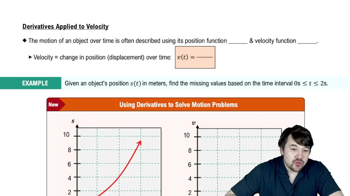
Average velocity is defined as the change in position over the change in time. Mathematically, it is calculated as the difference in the position function values at two points divided by the time interval between those points. This concept is crucial for understanding how an object's position changes over time and is foundational for analyzing motion.
추천 영상:
06:29
Derivatives Applied To Velocity

Instantaneous Velocity

Instantaneous velocity refers to the velocity of an object at a specific moment in time. It is defined as the limit of the average velocity as the time interval approaches zero. This concept is essential for understanding how an object's speed and direction change at any given instant, and it can be found using the derivative of the position function.
추천 영상:
06:29
Derivatives Applied To Velocity

Trigonometric Functions in Motion

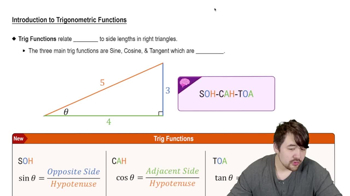
Trigonometric functions, such as sine and cosine, are often used to model periodic motion. In the context of the position function s(t) = 40 sin(2t), the sine function describes how the position varies with time in a wave-like manner. Understanding the properties of these functions, including their amplitude, period, and frequency, is vital for analyzing the motion described by such equations.
추천 영상:
6:04
Introduction to Trigonometric Functions