Ch. 2 - Limits
Briggs - Calculus: Early Transcendentals 3rd Edition
Briggs3rd EditionCalculus: Early TranscendentalsISBN: 9780136847243당신이 사용하는 게 아니라요?교과서 변경
2장, 문제 12c

Graph the function f(x)=e^−x / x(x+2)^2 using a graphing utility. (Experiment with your choice of a graphing window.) Use your graph to determine the following limits.


c. lim x→0^− f(x)

검증된 단계별 안내
1
Step 1: Understand the function. The function given is \( f(x) = \frac{e^{-x}}{x(x+2)^2} \). We need to analyze this function as \( x \) approaches 0 from the left (\( x \to 0^- \)).
Step 2: Consider the behavior of the function as \( x \to 0^- \). Note that the denominator \( x(x+2)^2 \) will approach 0, which suggests a potential vertical asymptote or undefined behavior at \( x = 0 \).
Step 3: Analyze the numerator and denominator separately. The numerator \( e^{-x} \) approaches \( e^0 = 1 \) as \( x \to 0^- \). The denominator \( x(x+2)^2 \) approaches 0, but since \( x \to 0^- \), \( x \) is negative, making the denominator negative.
Step 4: Combine the behavior of the numerator and denominator. Since the numerator approaches 1 and the denominator approaches a small negative value, the overall function \( f(x) \) will approach negative infinity as \( x \to 0^- \).
Step 5: Use a graphing utility to confirm the behavior. Graph \( f(x) = \frac{e^{-x}}{x(x+2)^2} \) and observe the behavior as \( x \to 0^- \). The graph should show the function approaching negative infinity, confirming the limit.

비슷한 문제에 대한 검증된 영상 답변:

이 영상 해법은 위 문제에 도움이 된다고 튜터들이 추천한 것입니다.
영상 길이:
1m
도움이 되었나요?

주요 개념

질문에 올바르게 답하기 위해 반드시 이해해야 하는 핵심 개념들은 다음과 같습니다.

Limits

Limits are fundamental in calculus, representing the value that a function approaches as the input approaches a certain point. In this context, evaluating the limit as x approaches 0 from the left (denoted as x→0^−) involves analyzing the behavior of the function f(x) near that point, which can reveal important characteristics about continuity and behavior of the function.
추천 영상:
05:50
One-Sided Limits

Graphing Functions

Graphing functions involves plotting the values of a function on a coordinate system to visualize its behavior. For the function f(x)=e^−x / x(x+2)^2, using a graphing utility allows for experimentation with different viewing windows, which can help identify asymptotic behavior, intercepts, and the overall shape of the graph, aiding in the understanding of limits.
추천 영상:
가이드 코스
5:53
Graph of Sine and Cosine Function

Asymptotic Behavior

Asymptotic behavior refers to how a function behaves as it approaches a certain point or infinity. In the case of f(x) as x approaches 0 from the left, understanding whether the function approaches a finite value, diverges to infinity, or approaches negative infinity is crucial for determining the limit. This behavior can often be inferred from the graph and the function's algebraic form.
추천 영상:
03:07
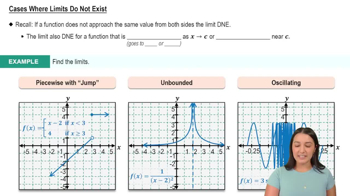
Cases Where Limits Do Not Exist
관련 실천
교과서 질문

The position of an object moving vertically along a line is given by the function s(t)=16t2+128ts\(\left\)(t\(\right\))=-16t^2+128t. Find the average velocity of the object over the following intervals.

[1,4]\(\left\[\lbrack\)1,4\(\right\]\rbrack\)

378
views
교과서 질문

Determine the following limits.

lim h→0 (h + 6)^2 + (h + 6) − 42 / h

358
views
교과서 질문

Graph the function f(x)=e^−x / x(x+2)^2 using a graphing utility. (Experiment with your choice of a graphing window.) Use your graph to determine the following limits.


d. lim x→0^+ f(x)

296
views
교과서 질문

Given the function f(x)=16x2+64xf\(\left\)(x\(\right\))=-16x^2+64x, complete the following. <IMAGE>

Find the slopes of the secant lines that pass though the points (x,f(x))\(\left\)(x,f\(\left\)(x\(\right\))\(\right\)) and (2,f(2))\(\left\)(2,f\(\left\)(2\(\right\))\(\right\)), for x=1.5,1.9,1.99,1.999,x=1.5,1.9,1.99,1.999, and 1.99991.9999 (see figure).

409
views
교과서 질문

Determine the following limits.

lim h→0 √5x + 5h − √5x / h, where x>0 Is constant

388
views
교과서 질문

Given the function f(x)=16x2+64xf\(\left\)(x\(\right\))=-16x^2+64x, complete the following. <IMAGE>

Make a conjecture about the value of the limit of the slopes of the secant lines that pass through (x,f(x))\(\left\)(x,f\(\left\)(x\(\right\))\(\right\)) and (2,f(2))\(\left\)(2,f\(\left\)(2\(\right\))\(\right\)) as xx approaches 22.

319
views