Ch. 2 - Limits
Briggs - Calculus: Early Transcendentals 3rd Edition
Briggs3rd EditionCalculus: Early TranscendentalsISBN: 9780136847243당신이 사용하는 게 아니라요?교과서 변경
2장, 문제 2.2.19

Sketch a graph of f and use it to make a conjecture about the values of f(a), lim x→a^−f(x),lim x→a^+f(x), and lim x→a f(x) or state that they do not exist.


f(x) = {x^2+1 if x≤−1
3 if x>−1; a=−1

검증된 단계별 안내
1
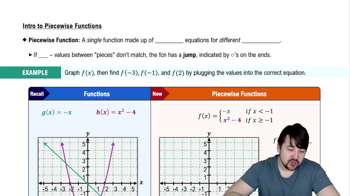
Step 1: Identify the piecewise function. The function f(x) is defined as f(x) = x^2 + 1 for x ≤ -1 and f(x) = 3 for x > -1. This means the function has two different expressions depending on the value of x relative to -1.
Step 2: Sketch the graph of f(x). For x ≤ -1, plot the graph of y = x^2 + 1, which is a parabola opening upwards with its vertex at (0, 1). For x > -1, plot the horizontal line y = 3. Note the point of transition at x = -1.
Step 3: Determine f(a). Since a = -1, use the expression for x ≤ -1, which is f(x) = x^2 + 1. Therefore, f(-1) = (-1)^2 + 1 = 2.
Step 4: Evaluate the left-hand limit, \( \lim_{x \to -1^-} f(x) \). As x approaches -1 from the left, f(x) follows the expression x^2 + 1. Thus, \( \lim_{x \to -1^-} f(x) = (-1)^2 + 1 = 2 \).
Step 5: Evaluate the right-hand limit, \( \lim_{x \to -1^+} f(x) \). As x approaches -1 from the right, f(x) is constant at 3. Thus, \( \lim_{x \to -1^+} f(x) = 3 \).

비슷한 문제에 대한 검증된 영상 답변:

이 영상 해법은 위 문제에 도움이 된다고 튜터들이 추천한 것입니다.
영상 길이:
6m
도움이 되었나요?

주요 개념

질문에 올바르게 답하기 위해 반드시 이해해야 하는 핵심 개념들은 다음과 같습니다.

Piecewise Functions

A piecewise function is defined by different expressions based on the input value. In this case, f(x) has two distinct definitions: one for x ≤ -1 and another for x > -1. Understanding how to evaluate piecewise functions at specific points is crucial for analyzing their behavior and limits.
추천 영상:
가이드 코스
05:36
Piecewise Functions

Limits

Limits describe the behavior of a function as the input approaches a certain value. The left-hand limit (lim x→a^−f(x)) and right-hand limit (lim x→a^+f(x)) are essential for determining continuity and the overall limit (lim x→a f(x)). Evaluating these limits helps in understanding how the function behaves around the point of interest.
추천 영상:
05:50
One-Sided Limits

Continuity

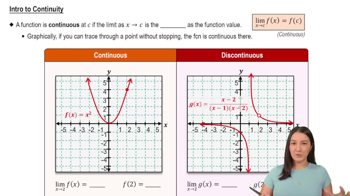
A function is continuous at a point if the limit as x approaches that point equals the function's value at that point. For the function f(x) at a = -1, checking continuity involves comparing f(-1) with the left-hand and right-hand limits. If these values do not match, the function is discontinuous at that point.
추천 영상:
05:34
Intro to Continuity