Ch. 2 - Limits
Briggs - Calculus: Early Transcendentals 3rd Edition
Briggs3rd EditionCalculus: Early TranscendentalsISBN: 9780136847243당신이 사용하는 게 아니라요?교과서 변경
2장, 문제 2.87

Use an appropriate limit definition to prove the following limits.


lim x→ 5x^2 − 25 / x − 5=10

검증된 단계별 안내
1
Identify the limit expression: \( \lim_{{x \to 5}} \frac{{x^2 - 25}}{{x - 5}} \).
Recognize that the expression \( x^2 - 25 \) can be factored as \((x - 5)(x + 5)\).
Rewrite the limit expression using the factorization: \( \lim_{{x \to 5}} \frac{{(x - 5)(x + 5)}}{{x - 5}} \).
Cancel the common factor \((x - 5)\) in the numerator and denominator, simplifying the expression to \( \lim_{{x \to 5}} (x + 5) \).
Evaluate the limit by direct substitution: substitute \(x = 5\) into the simplified expression \(x + 5\).

비슷한 문제에 대한 검증된 영상 답변:

이 영상 해법은 위 문제에 도움이 된다고 튜터들이 추천한 것입니다.
영상 길이:
3m
도움이 되었나요?

주요 개념

질문에 올바르게 답하기 위해 반드시 이해해야 하는 핵심 개념들은 다음과 같습니다.

Limit Definition

The limit definition in calculus refers to the formal approach to finding the limit of a function as it approaches a certain point. It involves evaluating the behavior of the function as the input values get arbitrarily close to a specified value, often denoted as 'a'. This concept is foundational for understanding continuity, derivatives, and integrals.
추천 영상:
05:50
One-Sided Limits

Factoring Polynomials

Factoring polynomials is the process of breaking down a polynomial expression into simpler components, or factors, that can be multiplied together to yield the original polynomial. In the context of limits, factoring can help simplify expressions that yield indeterminate forms, such as 0/0, allowing for easier evaluation of the limit.
추천 영상:
6:04
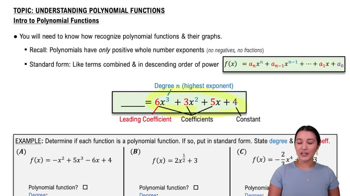
Introduction to Polynomial Functions

Indeterminate Forms

Indeterminate forms occur in calculus when evaluating limits leads to expressions that do not provide clear information about the limit's value, such as 0/0 or ∞/∞. Recognizing these forms is crucial, as they often require additional techniques, like factoring or L'Hôpital's Rule, to resolve and find the actual limit.
추천 영상:
가이드 코스
3:56
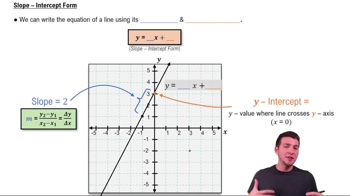
Slope-Intercept Form
관련 실천
교과서 질문

Determine limxf(x)\(\lim\)_{x\(\rightarrow\]\infty\)}f\(\left\)(x\(\right\)) and limxf(x)\(\lim\)_{x\(\rightarrow\)-\(\infty\)}f\(\left\)(x\(\right\)) for the following functions. Then give the horizontal asymptotes of ff (if any).


f(x)=6x29x+83x2+2f\(\left\)(x\(\right\))=\(\frac{6x^2-9x+8}{3x^2+2}\)

391
views
교과서 질문

Consider the position function s(t) =−16t^2+100t representing the position of an object moving vertically along a line. Sketch a graph of s with the secant line passing through (0.5, s(0.5)) and (2, s(2)). Determine the slope of the secant line and explain its relationship to the moving object.

370
views
교과서 질문

Sketch a graph of f and use it to make a conjecture about the values of f(a), lim x→a^−f(x),lim x→a^+f(x), and lim x→a f(x) or state that they do not exist.

f(x) = x^2+x−2 / x−1; a=1

386
views
교과서 질문

Use analytical methods and/or a graphing utility to identify the vertical asymptotes (if any) of the following functions.

f(x)=x^2−3x+2 / x^10−x^9

365
views
교과서 질문

A sequence is an infinite, ordered list of numbers that is often defined by a function. For example, the sequence {2,4,6,8,…} is specified by the function f(n) = 2n, where n=1,2,3,….The limit of such a sequence is lim n→∞ f(n), provided the limit exists. All the limit laws for limits at infinity may be applied to limits of sequences. Find the limit of the following sequences or state that the limit does not exist. 


{0,1/2,2/3,3/4,…}, which is defined by f(n) = (n−1) / n, for n=1,2,3,…

453
views
교과서 질문

Estimate the following limits using graphs or tables.

limh0ln(1+h)h{\(\displaystyle\]\lim\)_{h\(\to\)0}}\(\frac{\ln\left(1+h\right)}{h}\)

475
views