Ch. 2 - Limits
Briggs - Calculus: Early Transcendentals 3rd Edition
Briggs3rd EditionCalculus: Early TranscendentalsISBN: 9780136847243당신이 사용하는 게 아니라요?교과서 변경
2장, 문제 2.4.62

Use analytical methods and/or a graphing utility to identify the vertical asymptotes (if any) of the following functions.
h(x)=e^x(x+1)^3

검증된 단계별 안내
1
Step 1: Identify the form of the function h(x) = e^x (x+1)^3. Notice that it is a product of an exponential function and a polynomial.
Step 2: Recall that vertical asymptotes occur where the function is undefined or where the limit of the function approaches infinity as x approaches a certain value.
Step 3: Analyze the polynomial part (x+1)^3. Vertical asymptotes typically occur where the denominator of a rational function is zero, but since (x+1)^3 is not in the denominator, it does not contribute to vertical asymptotes.
Step 4: Consider the exponential part e^x. The exponential function e^x is defined for all real numbers and does not contribute to vertical asymptotes.
Step 5: Conclude that since neither part of the function h(x) = e^x (x+1)^3 leads to division by zero or undefined behavior, there are no vertical asymptotes for this function.

비슷한 문제에 대한 검증된 영상 답변:

이 영상 해법은 위 문제에 도움이 된다고 튜터들이 추천한 것입니다.
영상 길이:
2m
도움이 되었나요?

주요 개념

질문에 올바르게 답하기 위해 반드시 이해해야 하는 핵심 개념들은 다음과 같습니다.

Vertical Asymptotes

Vertical asymptotes occur in a function when the output approaches infinity as the input approaches a certain value. This typically happens when the function is undefined at that point, often due to division by zero. Identifying vertical asymptotes involves finding values of x that make the denominator of a rational function zero, while ensuring the numerator is not also zero at those points.
추천 영상:
3:40
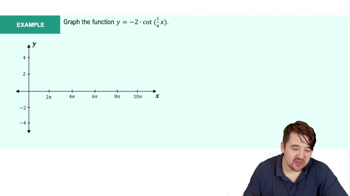
Introduction to Cotangent Graph Example 1

Exponential Functions

Exponential functions, such as h(x) = e^x, are characterized by a constant base raised to a variable exponent. These functions grow rapidly and are always positive, meaning they do not have vertical asymptotes. Understanding their behavior is crucial when analyzing composite functions, as they can influence the overall shape and limits of the function.
추천 영상:
6:13
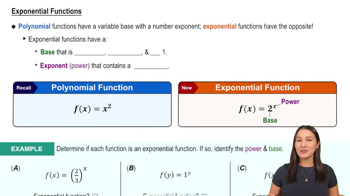
Exponential Functions

Polynomial Functions

Polynomial functions, like (x+1)^3, are expressions consisting of variables raised to whole number powers. They are continuous and defined for all real numbers, meaning they do not have vertical asymptotes. Analyzing the degree and roots of polynomial functions helps in understanding their behavior, particularly in conjunction with other function types in composite expressions.
추천 영상:
6:04
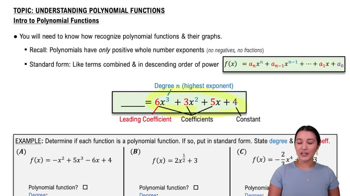
Introduction to Polynomial Functions
관련 실천
교과서 질문

Determine the following limits at infinity.


lim t→∞ et,lim t→−∞ e^t,and lim t→∞ e^−t

516
views
교과서 질문

If a function f represents a system that varies in time, the existence of lim limtf(t){\(\displaystyle\[\lim\)_{t\(\rightarrow\]\infty\)}{f(t)}} means that the system reaches a steady state (or equilibrium). For the following systems, determine whether a steady state exists and give the steady-state value.


The population of a colony of squirrels is given by p(t)=15003+2e0.1tp\(\left\)(t\(\right\))=\(\frac{1500}{3+2e^{-0.1t}\)}.

366
views
교과서 질문

Determine limxf(x)\(\lim\)_{x\(\rightarrow\]\infty\)}f\(\left\)(x\(\right\)) and limxf(x)\(\lim\)_{x\(\rightarrow\)-\(\infty\)}f\(\left\)(x\(\right\)) for the following functions. Then give the horizontal asymptotes of ff (if any).


f(x)=40x5+x216x42xf\(\left\)(x\(\right\))=\(\frac{40x^5+x^2}{16x^4-2x}\)

367
views
교과서 질문

The following table gives the position s(t)s\(\left\)(t\(\right\)) of an object moving along a line at time tt. Determine the average velocities over the time intervals [1,1.01]\(\left\[\lbrack\)1,1.01\(\right\]\rbrack\), [1,1.001]\(\left\[\lbrack\)1,1.001\(\right\]\rbrack\), and [1,1.0001]\(\left\]\lbrack\)1,1.0001^{}\(\right\).]. Then make a conjecture about the value of the instantaneous velocity at t=1t=1. <IMAGE>

380
views
교과서 질문

Evaluate each limit and justify your answer. 

lim x→1 (x+5x / x+2)^4

369
views
교과서 질문

Find polynomials p and q such that f=p/q is undefined at 1 and 2, but f has a vertical asymptote only at 2. Sketch a graph of your function.

377
views