Ch. 2 - Limits
Briggs - Calculus: Early Transcendentals 3rd Edition
Briggs3rd EditionCalculus: Early TranscendentalsISBN: 9780136847243당신이 사용하는 게 아니라요?교과서 변경
2장, 문제 15c

Use the graph of f in the figure to find the following values or state that they do not exist. If a limit does not exist, explain why. <IMAGE>
limx→1+f(x)\(\lim\)_{x\(\to\)1^{+}}f\(\left\)(x\(\right\))

검증된 단계별 안내
1
Identify the behavior of the function \( f(x) \) as \( x \) approaches 1 from the right (\( x \to 1^+ \)).
Examine the graph of \( f(x) \) to observe the values of \( f(x) \) as \( x \) gets closer to 1 from values greater than 1.
Determine if \( f(x) \) approaches a specific value, or if it diverges or oscillates as \( x \to 1^+ \).
If \( f(x) \) approaches a specific value, that value is the right-hand limit, \( \lim_{x\to1^{+}}f(x) \).
If \( f(x) \) does not approach a specific value, state that the limit does not exist and provide a reason based on the graph's behavior.

비슷한 문제에 대한 검증된 영상 답변:

이 영상 해법은 위 문제에 도움이 된다고 튜터들이 추천한 것입니다.
영상 길이:
1m

주요 개념

질문에 올바르게 답하기 위해 반드시 이해해야 하는 핵심 개념들은 다음과 같습니다.

Limits

A limit is a fundamental concept in calculus that describes the behavior of a function as its input approaches a certain value. It helps in understanding how functions behave near points of interest, including points where they may not be defined. For example, the limit of f(x) as x approaches 1 from the right (denoted as lim x→1⁺ f(x)) examines the values f(x) takes as x gets closer to 1 from values greater than 1.
추천 영상:
05:50
One-Sided Limits

One-Sided Limits

One-sided limits are specific types of limits that consider the behavior of a function as the input approaches a particular value from one side only. The right-hand limit (lim x→1⁺ f(x)) looks at values approaching from the right, while the left-hand limit (lim x→1⁻ f(x)) considers values approaching from the left. Understanding one-sided limits is crucial for determining the overall limit at a point, especially when the function exhibits different behaviors from each side.
추천 영상:
05:50
One-Sided Limits

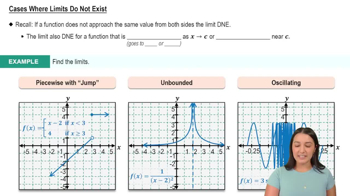
Existence of Limits

A limit exists if both the left-hand and right-hand limits at a point are equal. If they differ, the limit does not exist. Additionally, if the function approaches infinity or oscillates without settling at a value, the limit is also considered non-existent. Analyzing the existence of limits is essential for understanding continuity and the overall behavior of functions at specific points.
추천 영상:
03:07
Cases Where Limits Do Not Exist