Ch. 2 - Limits
Briggs - Calculus: Early Transcendentals 3rd Edition
Briggs3rd EditionCalculus: Early TranscendentalsISBN: 9780136847243당신이 사용하는 게 아니라요?교과서 변경
2장, 문제 2.7.45

Use the precise definition of infinite limits to prove the following limits.


limx41(x4)2={\(\displaystyle\]\lim\)_{x\(\to\)4}}\(\frac{1}{\left(x-4\right)^2}\)=\(\infty\)

검증된 단계별 안내
1
Step 1: Understand the definition of an infinite limit. The statement \( \lim_{{x \to 4}} \frac{1}{{(x-4)^2}} = \infty \) means that for every positive number \( M \), there exists a \( \delta > 0 \) such that if \( 0 < |x - 4| < \delta \), then \( \frac{1}{{(x-4)^2}} > M \).
Step 2: Start by manipulating the inequality \( \frac{1}{{(x-4)^2}} > M \). This can be rewritten as \( (x-4)^2 < \frac{1}{M} \).
Step 3: Solve the inequality \( (x-4)^2 < \frac{1}{M} \) for \( x \). This gives \( |x-4| < \frac{1}{\sqrt{M}} \).
Step 4: Choose \( \delta = \frac{1}{\sqrt{M}} \). This choice of \( \delta \) ensures that whenever \( 0 < |x - 4| < \delta \), the inequality \( \frac{1}{{(x-4)^2}} > M \) holds true.
Step 5: Conclude that since for every \( M > 0 \), there exists a \( \delta = \frac{1}{\sqrt{M}} \) such that \( 0 < |x - 4| < \delta \) implies \( \frac{1}{{(x-4)^2}} > M \), the limit \( \lim_{{x \to 4}} \frac{1}{{(x-4)^2}} = \infty \) is proven.

비슷한 문제에 대한 검증된 영상 답변:

이 영상 해법은 위 문제에 도움이 된다고 튜터들이 추천한 것입니다.
영상 길이:
4m
도움이 되었나요?

주요 개념

질문에 올바르게 답하기 위해 반드시 이해해야 하는 핵심 개념들은 다음과 같습니다.

Infinite Limits

Infinite limits describe the behavior of a function as the input approaches a certain value, where the output grows without bound. Specifically, if the limit of a function as x approaches a value c is infinity, it indicates that the function's values increase indefinitely as x gets closer to c. This concept is crucial for understanding how functions behave near points of discontinuity or vertical asymptotes.
추천 영상:
05:50
One-Sided Limits

Limit Definition

The formal definition of a limit involves the epsilon-delta criterion, which provides a rigorous way to describe the behavior of functions as they approach a specific point. For a limit to exist, for every small positive number (epsilon), there must be a corresponding small distance (delta) such that if the input is within that distance of the point, the output is within the specified range. This definition is foundational for proving limits, especially in cases involving infinity.
추천 영상:
05:43
Definition of the Definite Integral

Continuity and Discontinuity

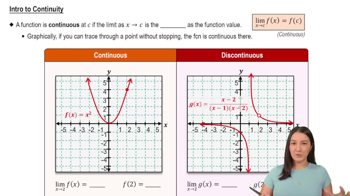
Continuity at a point means that a function is defined at that point, the limit exists, and the limit equals the function's value. Discontinuity occurs when any of these conditions fail, often leading to infinite limits. Understanding the types of discontinuities, such as removable or essential, is essential for analyzing limits, particularly when approaching points where the function may not be defined or behaves erratically.
추천 영상:
05:34
Intro to Continuity