Ch. 2 - Limits
Briggs - Calculus: Early Transcendentals 3rd Edition
Briggs3rd EditionCalculus: Early TranscendentalsISBN: 9780136847243당신이 사용하는 게 아니라요?교과서 변경
2장, 문제 1d

Which of the following functions are continuous for all values in their domain? Justify your answers.


d. p(t)=number of points scored by a basketball player after t minutes of a basketball game

검증된 단계별 안내
1
p>1. **Understand the Function**: The function \( p(t) \) represents the number of points scored by a basketball player after \( t \) minutes of a game. This is a real-world scenario where the function is defined in terms of time and points scored.
p>2. **Identify the Nature of the Function**: In this context, \( p(t) \) is a step function. A step function is a piecewise constant function that jumps from one value to another without taking on intermediate values. In a basketball game, points are scored in discrete amounts (e.g., 2 points for a field goal, 3 points for a three-pointer), and the score changes instantaneously at the moment a basket is made.
p>3. **Determine Continuity**: A function is continuous if there are no breaks, jumps, or holes in its graph. For \( p(t) \), since it is a step function, it will have jumps at the moments when points are scored. Therefore, \( p(t) \) is not continuous because it has discontinuities at the times when the player scores.
p>4. **Consider the Domain**: The domain of \( p(t) \) is the duration of the basketball game, typically from \( t = 0 \) to the end of the game. Within this domain, the function is defined, but it is not continuous due to the nature of scoring in discrete steps.
p>5. **Conclusion**: Conclude that \( p(t) \) is not continuous for all values in its domain because it is a step function with jumps at the points where the player scores.

비슷한 문제에 대한 검증된 영상 답변:

이 영상 해법은 위 문제에 도움이 된다고 튜터들이 추천한 것입니다.
영상 길이:
2m
도움이 되었나요?

주요 개념

질문에 올바르게 답하기 위해 반드시 이해해야 하는 핵심 개념들은 다음과 같습니다.

Continuity of Functions

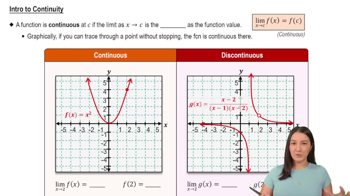
A function is continuous at a point if the limit of the function as it approaches that point equals the function's value at that point. For a function to be continuous over its entire domain, it must be continuous at every point in that domain. This means there are no breaks, jumps, or asymptotes in the function's graph.
추천 영상:
05:34
Intro to Continuity

Domain of a Function

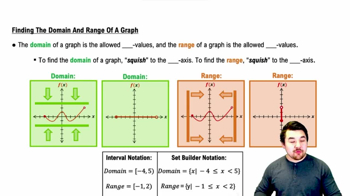
The domain of a function is the set of all possible input values (x-values) for which the function is defined. Understanding the domain is crucial for determining continuity, as a function may be continuous within its domain but not defined outside of it. For example, a function that involves division cannot include values that make the denominator zero.
추천 영상:
5:10
Finding the Domain and Range of a Graph

Real-World Applications of Functions

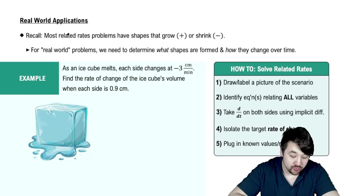
In real-world scenarios, such as the scoring of a basketball player over time, functions can model behaviors that are inherently continuous. For instance, the number of points scored can be represented as a function of time, where the function is continuous as long as points are scored in a consistent manner without sudden jumps, reflecting the natural flow of the game.
추천 영상:
06:16
Real World Application