Ch. 3 - Derivatives
Briggs - Calculus: Early Transcendentals 3rd Edition
Briggs3rd EditionCalculus: Early TranscendentalsISBN: 9780136847243당신이 사용하는 게 아니라요?교과서 변경
3장, 문제 3.8.14b

13-26 Implicit differentiation Carry out the following steps.
b. Find the slope of the curve at the given point.
x = e^y; (2, ln 2)

검증된 단계별 안내
1
Start by recognizing that the equation given is in implicit form: \( x = e^y \). This means that \( y \) is not isolated on one side of the equation.
To find the derivative \( \frac{dy}{dx} \), apply implicit differentiation to both sides of the equation with respect to \( x \). Differentiate \( x \) to get 1, and differentiate \( e^y \) using the chain rule to get \( e^y \cdot \frac{dy}{dx} \).
Set up the equation from the differentiation: \( 1 = e^y \cdot \frac{dy}{dx} \).
Solve for \( \frac{dy}{dx} \) by isolating it on one side of the equation: \( \frac{dy}{dx} = \frac{1}{e^y} \).
Substitute the given point \((2, \ln 2)\) into the expression for \( \frac{dy}{dx} \). Since \( y = \ln 2 \), calculate \( e^{\ln 2} \) which simplifies to 2, and find the slope at this point.

비슷한 문제에 대한 검증된 영상 답변:

이 영상 해법은 위 문제에 도움이 된다고 튜터들이 추천한 것입니다.
영상 길이:
4m

주요 개념

질문에 올바르게 답하기 위해 반드시 이해해야 하는 핵심 개념들은 다음과 같습니다.

Implicit Differentiation

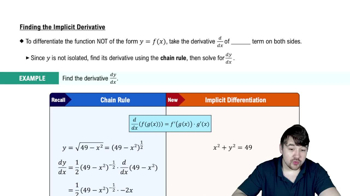
Implicit differentiation is a technique used to differentiate equations where the dependent and independent variables are not explicitly separated. Instead of solving for one variable in terms of the other, we differentiate both sides of the equation with respect to the independent variable, applying the chain rule as necessary. This method is particularly useful for curves defined by equations that cannot be easily rearranged.
추천 영상:
가이드 코스
05:14
Finding The Implicit Derivative

Slope of a Curve

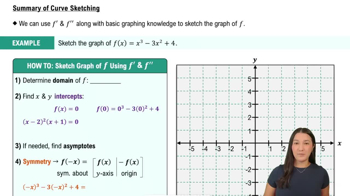
The slope of a curve at a given point represents the rate of change of the function at that point, which is mathematically defined as the derivative of the function. For a curve defined implicitly, the slope can be found by evaluating the derivative obtained through implicit differentiation. The slope is often denoted as 'dy/dx' and indicates how steep the curve is at the specified coordinates.
추천 영상:
11:41
Summary of Curve Sketching

Exponential and Natural Logarithm Functions

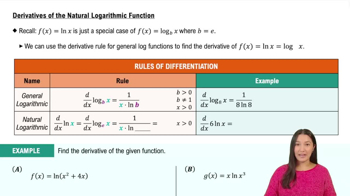
Exponential functions, such as e^y, and natural logarithm functions, like ln(x), are fundamental in calculus. The function e^y is the inverse of ln(y), and they exhibit unique properties, such as the derivative of e^y being e^y dy/dx. Understanding these functions is crucial for evaluating expressions and derivatives involving exponential growth or decay, especially when working with implicit relationships.
추천 영상:
05:18
Derivative of the Natural Logarithmic Function
관련 실천
교과서 질문

60–62. {Use of Tech} Multiple tangent lines Complete the following steps. <IMAGE>

b. Graph the tangent lines on the given graph.

x+y³−y=1; x=1

170
views

교과서 질문

13-26 Implicit differentiation Carry out the following steps.

b. Find the slope of the curve at the given point.

(x+y)^2/3=y; (4, 4)

271
views
교과서 질문

{Use of Tech} A mixing tank A 500-liter (L) tank is filled with pure water. At time t=0, a salt solution begins flowing into the tank at a rate of 5 L/min. At the same time, the (fully mixed) solution flows out of the tank at a rate of 5.5 L/min. The mass of salt in grams in the tank at any time t≥0 is given by M(t) = 250(1000−t)(1−10−³⁰(1000−t)¹⁰) and the volume of solution in the tank is given by V(t) = 500-0.5t.

b. Graph the volume function and verify that the tank is empty when t=1000 min. 

275
views
교과서 질문

Throwing a stone Suppose a stone is thrown vertically upward from the edge of a cliff on Earth with an initial velocity of 32 ft/s from a height of 48 ft above the ground. The height (in feet) of the stone above the ground t seconds after it is thrown is s(t) = -16t²+32t+48.

b. When does the stone reach its highest point?

184
views
교과서 질문

Product Rule for three functions Assume f, g, and h are differentiable at x.

b. Use the formula in (a) to find d/dx(e^x(x−1)(x+3))

418
views
교과서 질문

Tracking a dive A biologist standing at the bottom of an 80-foot vertical cliff watches a peregrine falcon dive from the top of the cliff at a 45° angle from the horizontal (see figure). <IMAGE>


b. What is the rate of change of θ with respect to the bird’s height when it is 60 ft above the ground?

141
views