Ch. 3 - Derivatives
Briggs - Calculus: Early Transcendentals 3rd Edition
Briggs3rd EditionCalculus: Early TranscendentalsISBN: 9780136847243당신이 사용하는 게 아니라요?교과서 변경
3장, 문제 3.2.25b

21–30. Derivatives
b. Evaluate f'(a) for the given values of a.
f(x) = 1/x+1; a = -1/2;5

검증된 단계별 안내
1
Step 1: Identify the function f(x) = \(\frac{1}{x}\) + 1 and the points a = -\(\frac{1}{2}\) and a = 5 where we need to evaluate the derivative f'(a).
Step 2: Find the derivative of the function f(x). The function can be rewritten as f(x) = x^{-1} + 1. Use the power rule for derivatives, which states that \(\frac{d}{dx}\)[x^n] = nx^{n-1}, to find f'(x).
Step 3: Apply the power rule to f(x) = x^{-1} + 1. The derivative of x^{-1} is -x^{-2}, and the derivative of a constant (1) is 0. Therefore, f'(x) = -x^{-2}.
Step 4: Evaluate f'(x) at a = -\(\frac{1}{2}\). Substitute x = -\(\frac{1}{2}\) into f'(x) = -x^{-2} to find f'(-\(\frac{1}{2}\)).
Step 5: Evaluate f'(x) at a = 5. Substitute x = 5 into f'(x) = -x^{-2} to find f'(5).

비슷한 문제에 대한 검증된 영상 답변:

이 영상 해법은 위 문제에 도움이 된다고 튜터들이 추천한 것입니다.
영상 길이:
7m

주요 개념

질문에 올바르게 답하기 위해 반드시 이해해야 하는 핵심 개념들은 다음과 같습니다.

Derivatives

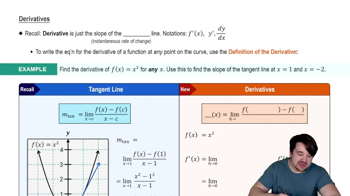
A derivative represents the rate of change of a function with respect to its variable. It is a fundamental concept in calculus that provides information about the slope of the tangent line to the curve of the function at a given point. The derivative can be computed using various rules, such as the power rule, product rule, and quotient rule, depending on the form of the function.
추천 영상:

Quotient Rule

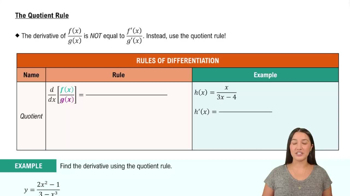
The quotient rule is a method for finding the derivative of a function that is the ratio of two other functions. If f(x) = g(x)/h(x), the derivative f'(x) is given by f'(x) = (g'(x)h(x) - g(x)h'(x)) / (h(x))^2. This rule is essential when dealing with functions that involve division, such as the function f(x) = 1/(x+1) in the given question.
추천 영상:
06:43
The Quotient Rule

Evaluating Derivatives at Specific Points

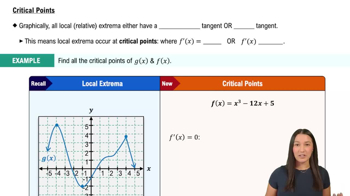
Evaluating the derivative at a specific point involves substituting the value of that point into the derivative function. This process provides the slope of the tangent line to the function at that particular point, which can be useful for understanding the behavior of the function. In this case, we need to compute f'(-1/2) and f'(5) to analyze the function's behavior at these values.
추천 영상:
04:50
Critical Points
관련 실천
교과서 질문

Vertical tangent lines

b. Does the curve have any horizontal tangent lines? Explain.

313
views

교과서 질문

45–50. Tangent lines Carry out the following steps. <IMAGE>

b. Determine an equation of the line tangent to the curve at the given point.

x³+y³=2xy; (1, 1)

269
views
교과서 질문

Explain why or why not. Determine whether the following statements are true and give an explanation or counterexample.


b. ln(x + 1) + ln(x − 1) = ln(x² − 1), for all x.

155
views
교과서 질문

Explain why or why not Determine whether the following statements are true and give an explanation or counter example.

b. d²/dx² (sin x) = sin x.

176
views
교과서 질문

{Use of Tech} Spring oscillations A spring hangs from the ceiling at equilibrium with a mass attached to its end. Suppose you pull downward on the mass and release it 10 inches below its equilibrium position with an upward push. The distance x (in inches) of the mass from its equilibrium position after t seconds is given by the function x(t) = 10sin t - 10cos t, where x is positive when the mass is above the equilibrium position. <IMAGE>

b. Find dx/dt and interpret the meaning of this derivative.  

208
views
교과서 질문

109-112 {Use of Tech} Calculating limits The following limits are the derivatives of a composite function g at a point a.

b. Use the Chain Rule to find each limit. Verify your answer by using a calculator.

limx→04+sin(x)−2x{\(\displaystyle\)\(\lim\)_{x\(\to\)0}}\(\frac{\sqrt{4+\sin\left(x\right)}\)-2}{x}

263
views