Ch. 3 - Derivatives
Briggs - Calculus: Early Transcendentals 3rd Edition
Briggs3rd EditionCalculus: Early TranscendentalsISBN: 9780136847243당신이 사용하는 게 아니라요?교과서 변경
3장, 문제 3.8.52

51–56. Second derivatives Find d²y/dx².
2x²+y² = 4

검증된 단계별 안내
1
First, identify the given equation: \(2x^2 + y^2 = 4\). This is an implicit function of \(x\) and \(y\).
Differentiate both sides of the equation with respect to \(x\) to find the first derivative \(\frac{dy}{dx}\). Use implicit differentiation: \(\frac{d}{dx}(2x^2) + \frac{d}{dx}(y^2) = \frac{d}{dx}(4)\).
Calculate the derivatives: \(\frac{d}{dx}(2x^2) = 4x\) and \(\frac{d}{dx}(y^2) = 2y \frac{dy}{dx}\). The right side derivative is zero since \(4\) is a constant.
Set up the equation from the derivatives: \(4x + 2y \frac{dy}{dx} = 0\). Solve for \(\frac{dy}{dx}\) to find the first derivative.
Differentiate \(\frac{dy}{dx}\) again with respect to \(x\) to find \(\frac{d^2y}{dx^2}\). Use the quotient rule or implicit differentiation as needed, and substitute \(\frac{dy}{dx}\) from the previous step into this new derivative.

비슷한 문제에 대한 검증된 영상 답변:

이 영상 해법은 위 문제에 도움이 된다고 튜터들이 추천한 것입니다.
영상 길이:
9m
도움이 되었나요?

주요 개념

질문에 올바르게 답하기 위해 반드시 이해해야 하는 핵심 개념들은 다음과 같습니다.

Implicit Differentiation

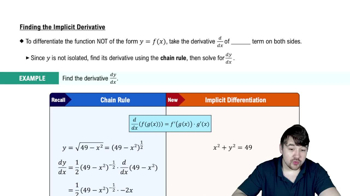
Implicit differentiation is a technique used to differentiate equations where the dependent and independent variables are not explicitly separated. In this case, the equation 2x² + y² = 4 involves both x and y, making it necessary to differentiate both sides with respect to x while treating y as a function of x. This allows us to find the first derivative dy/dx before proceeding to the second derivative.
추천 영상:
가이드 코스
05:14
Finding The Implicit Derivative

First Derivative

The first derivative, denoted as dy/dx, represents the rate of change of the dependent variable y with respect to the independent variable x. It provides information about the slope of the tangent line to the curve defined by the equation at any given point. To find the second derivative, we first need to compute the first derivative using implicit differentiation.
추천 영상:
07:09
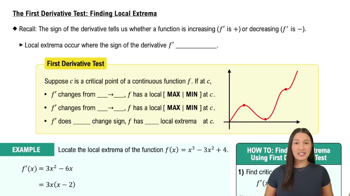
The First Derivative Test: Finding Local Extrema

Second Derivative

The second derivative, denoted as d²y/dx², measures the rate of change of the first derivative. It provides insights into the curvature of the function, indicating whether the function is concave up or concave down at a given point. To find d²y/dx², we differentiate the first derivative again, applying implicit differentiation as necessary to account for the relationship between x and y.
추천 영상:
06:02
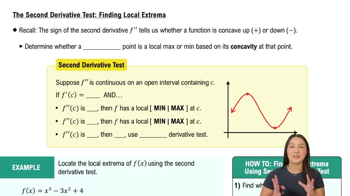
The Second Derivative Test: Finding Local Extrema