Ch. 3 - Derivatives
Briggs - Calculus: Early Transcendentals 3rd Edition
Briggs3rd EditionCalculus: Early TranscendentalsISBN: 9780136847243당신이 사용하는 게 아니라요?교과서 변경
3장, 문제 3.9.80

75–86. Logarithmic differentiation Use logarithmic differentiation to evaluate f'(x).
f(x) = tan¹⁰x / (5x+3)⁶

검증된 단계별 안내
1
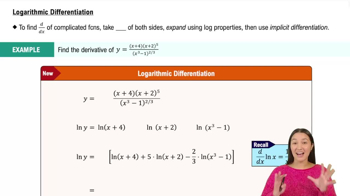
Step 1: Begin by taking the natural logarithm of both sides of the equation y = (tan^10(x)) / (5x + 3)^6. This gives ln(y) = ln((tan^10(x)) / (5x + 3)^6).
Step 2: Use the properties of logarithms to simplify the expression. The logarithm of a quotient is the difference of the logarithms: ln(y) = ln(tan^10(x)) - ln((5x + 3)^6).
Step 3: Apply the power rule for logarithms, which states that ln(a^b) = b*ln(a). This gives ln(y) = 10*ln(tan(x)) - 6*ln(5x + 3).
Step 4: Differentiate both sides with respect to x. The left side becomes (1/y) * dy/dx by implicit differentiation. The right side requires the chain rule: 10 * (1/tan(x)) * sec^2(x) - 6 * (1/(5x + 3)) * 5.
Step 5: Solve for dy/dx by multiplying both sides by y. Substitute back y = (tan^10(x)) / (5x + 3)^6 to express dy/dx in terms of x. This gives dy/dx = y * [10 * (1/tan(x)) * sec^2(x) - 6 * (1/(5x + 3)) * 5].

비슷한 문제에 대한 검증된 영상 답변:

이 영상 해법은 위 문제에 도움이 된다고 튜터들이 추천한 것입니다.
영상 길이:
6m
도움이 되었나요?

주요 개념

질문에 올바르게 답하기 위해 반드시 이해해야 하는 핵심 개념들은 다음과 같습니다.

Logarithmic Differentiation

Logarithmic differentiation is a technique used to differentiate functions that are products or quotients of other functions, especially when they involve powers. By taking the natural logarithm of both sides of the function, we can simplify the differentiation process, allowing us to use properties of logarithms to break down complex expressions into manageable parts.
추천 영상:
06:30
Logarithmic Differentiation

Chain Rule

The chain rule is a fundamental principle in calculus used to differentiate composite functions. It states that if a function y is composed of another function u, then the derivative of y with respect to x can be found by multiplying the derivative of y with respect to u by the derivative of u with respect to x. This is essential when dealing with functions raised to powers or nested functions.
추천 영상:
05:02
Intro to the Chain Rule

Product and Quotient Rules

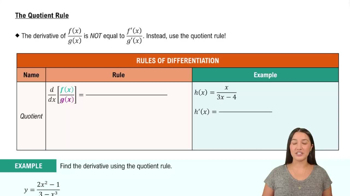
The product and quotient rules are essential for differentiating functions that are products or ratios of two or more functions. The product rule states that the derivative of a product of two functions is the first function times the derivative of the second plus the second function times the derivative of the first. The quotient rule, on the other hand, provides a method for differentiating a ratio of two functions, ensuring accurate results when applying these rules in logarithmic differentiation.
추천 영상:
06:43
The Quotient Rule
관련 실천
교과서 질문

Angle to a particle (part 2) The figure in Exercise 81 shows the particle traveling away from the sensor, which may have influenced your solution (we expect you used the inverse sine function). Suppose instead that the particle approaches the sensor (see figure). How would this change the solution? Explain the differences in the two answers. <IMAGE>

133
views
교과서 질문

49–55. Derivatives of tower functions (or g^h) Find the derivative of each function and evaluate the derivative at the given value of a.

h (x) = x^√x; a = 4

157
views
교과서 질문

27–40. Implicit differentiation Use implicit differentiation to find dy/dx.

√x⁴+y² = 5x+2y³

304
views
교과서 질문

Vertical tangent lines If a function f is continuous at a and lim x→a| f′(x)|=∞, then the curve y=f(x) has a vertical tangent line at a, and the equation of the tangent line is x=a. If a is an endpoint of a domain, then the appropriate one-sided derivative (Exercises 71–72) is used. Use this information to answer the following questions.

Graph the following curves and determine the location of any vertical tangent lines.

a. x²+y² = 9

247
views
교과서 질문

If f is a one-to-one function with f(3)=8 and f′(3)=7, find the equation of the line tangent to y=f^−1(x) at x=8.

192
views
교과서 질문

A 12-ft ladder is leaning against a vertical wall when Jack begins pulling the foot of the ladder away from the wall at a rate of 0.2 ft/s. What is the configuration of the ladder at the instant when the vertical speed of the top of the ladder equals the horizontal speed of the foot of the ladder?

260
views