
Ch. 3 - Derivatives
Briggs - Calculus: Early Transcendentals 3rd Edition
Briggs3rd EditionCalculus: Early TranscendentalsISBN: 9780136847243당신이 사용하는 게 아니라요?교과서 변경
3장, 문제 3.11.26b

A bug is moving along the right side of the parabola y=x² at a rate such that its distance from the origin is increasing at 1 cm/min.
b. Use the equation y=x² to find an equation relating dy/dt to dx/dt.

검증된 단계별 안내
1
Start by understanding the problem: We have a bug moving along the parabola y = x², and its distance from the origin is increasing at a rate of 1 cm/min. We need to find a relationship between dy/dt and dx/dt.
Recall that the distance from the origin to a point (x, y) on the parabola is given by the distance formula: d = √(x² + y²). Since y = x², substitute y in the distance formula to get d = √(x² + (x²)²) = √(x² + x⁴).
Differentiate the distance formula with respect to time t to find the rate of change of distance: d(d)/dt = (1/2) * (1/√(x² + x⁴)) * (2x * dx/dt + 4x³ * dx/dt). Set this equal to 1 cm/min, as given in the problem.
Now, differentiate the equation y = x² with respect to time t to find dy/dt: dy/dt = 2x * dx/dt.
Combine the results from the differentiation of the distance formula and the parabola equation to express dy/dt in terms of dx/dt. Use the fact that d(d)/dt = 1 cm/min to solve for dy/dt in terms of dx/dt.

비슷한 문제에 대한 검증된 영상 답변:

이 영상 해법은 위 문제에 도움이 된다고 튜터들이 추천한 것입니다.
영상 길이:
5m
도움이 되었나요?

주요 개념

질문에 올바르게 답하기 위해 반드시 이해해야 하는 핵심 개념들은 다음과 같습니다.

Related Rates

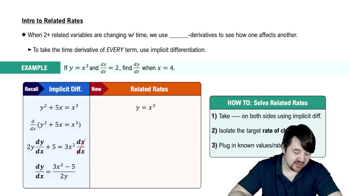
Related rates involve finding the rate at which one quantity changes in relation to another. In this problem, we need to relate the rates of change of the bug's position along the parabola (dx/dt and dy/dt) to its distance from the origin. This concept is essential for setting up the equations that will allow us to solve for the desired rates.
추천 영상:
가이드 코스
04:16
Intro To Related Rates

Implicit Differentiation

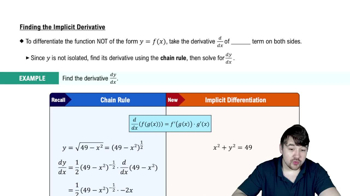
Implicit differentiation is a technique used to differentiate equations that define y implicitly in terms of x. Since the bug's position is described by the equation y = x², we can differentiate both sides with respect to time t to find a relationship between dy/dt and dx/dt. This method is crucial for relating the rates of change in this context.
추천 영상:
가이드 코스
05:14
Finding The Implicit Derivative

Distance Formula

The distance formula calculates the distance between two points in a coordinate system. In this scenario, the distance from the origin to the bug's position on the parabola can be expressed as D = √(x² + y²). Understanding this formula is vital for determining how the distance changes over time, which is central to solving the problem.
추천 영상:
5:04
Converting between Degrees & Radians
관련 실천
교과서 질문

Owlet talons Let L (t) equal the average length (in mm) of the middle talon on an Indian spotted owlet that is t weeks old, as shown in the figure.<IMAGE>

b. Estimate the value of L'(a) for a ≥ 4 . What does this tell you about the talon lengths on these birds? (Source: ZooKeys, 132, 2011)

178
views
교과서 질문

{Use of Tech} Bungee jumper A woman attached to a bungee cord jumps from a bridge that is 30 m above a river. Her height in meters above the river t seconds after the jump is y(t) = 15(1+e^−t cos t), for t ≥ 0.

b. Use a graphing utility to determine when she is moving downward and when she is moving upward during the first 10 s.  

256
views
교과서 질문

Velocity of a car The graph shows the position s=f(t) of a car t hours after 5:00 P.M. relative to its starting point s=0,where s is measured in miles. <IMAGE>

b. At approximately what time is the car traveling the fastest? The slowest?

253
views
교과서 질문

109-112 {Use of Tech} Calculating limits The following limits are the derivatives of a composite function g at a point a.

b. Use the Chain Rule to find each limit. Verify your answer by using a calculator.

limx2(x23)51x2{\(\displaystyle\]\lim\)_{x\(\to\)2}}\(\frac{\left(x^2-3\right)^5-1}{x-2}\)

383
views
교과서 질문

21–30. Derivatives

b. Evaluate f'(a) for the given values of a.

f(s) = 4s³+3s; a= -3, -1

353
views
교과서 질문

{Use of Tech} Fuel economy Suppose you own a fuel-efficient hybrid automobile with a monitor on the dashboard that displays the mileage and gas consumption. The number of miles you can drive with g gallons of gas remaining in the tank on a particular stretch of highway is given by m(g) = 50g−25.8g²+12.5g³−1.6g⁴, for 0≤g≤4.

b. Graph and interpret the gas mileage m(g)/g. 

241
views