Ch. 3 - Derivatives
Briggs - Calculus: Early Transcendentals 3rd Edition
Briggs3rd EditionCalculus: Early TranscendentalsISBN: 9780136847243당신이 사용하는 게 아니라요?교과서 변경
3장, 문제 3.6.7

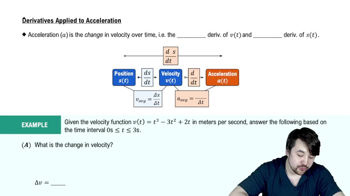
Define the acceleration of an object moving in a straight line.

검증된 단계별 안내
1
Acceleration is defined as the rate of change of velocity of an object with respect to time. It is a vector quantity, meaning it has both magnitude and direction.
To find the acceleration, you need to know the velocity function of the object, which is typically given as v(t), where t represents time.
The acceleration a(t) can be found by taking the derivative of the velocity function v(t) with respect to time t. This is expressed mathematically as: a(t)=dv(t)dt
If the velocity function v(t) is given, apply the rules of differentiation to find the derivative. This involves using techniques such as the power rule, product rule, or chain rule, depending on the form of v(t).
Once you have calculated the derivative, you have the acceleration function a(t), which describes how the velocity of the object changes over time.

비슷한 문제에 대한 검증된 영상 답변:

이 영상 해법은 위 문제에 도움이 된다고 튜터들이 추천한 것입니다.
영상 길이:
2m
도움이 되었나요?

주요 개념

질문에 올바르게 답하기 위해 반드시 이해해야 하는 핵심 개념들은 다음과 같습니다.

Acceleration

Acceleration is defined as the rate of change of velocity of an object with respect to time. It indicates how quickly an object is speeding up or slowing down. Mathematically, it is expressed as the derivative of velocity with respect to time, and it can be positive (indicating an increase in speed) or negative (indicating a decrease in speed).
추천 영상:
가이드 코스
06:15
Derivatives Applied To Acceleration

Velocity

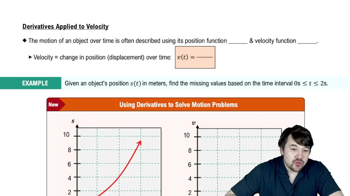
Velocity is a vector quantity that describes the rate at which an object changes its position. It includes both the speed of the object and the direction of its motion. Understanding velocity is crucial for calculating acceleration, as acceleration is derived from changes in velocity over time.
추천 영상:
가이드 코스
06:29
Derivatives Applied To Velocity

Kinematics

Kinematics is the branch of mechanics that deals with the motion of objects without considering the forces that cause the motion. It provides the foundational equations and concepts, such as displacement, velocity, and acceleration, which are essential for analyzing the motion of objects in a straight line.