Ch. 3 - Derivatives
Briggs - Calculus: Early Transcendentals 3rd Edition
Briggs3rd EditionCalculus: Early TranscendentalsISBN: 9780136847243당신이 사용하는 게 아니라요?교과서 변경
3장, 문제 38a

Derivatives and tangent lines
a. For the following functions and values of a, find f′(a).
f(x) = 1/ x²; a= 1

검증된 단계별 안내
1
Step 1: Identify the function f(x) = \(\frac{1}{x^2}\) and the point a = 1 where you need to find the derivative f'(a).
Step 2: Rewrite the function in a form that is easier to differentiate: f(x) = x^{-2}.
Step 3: Use the power rule for differentiation, which states that if f(x) = x^n, then f'(x) = nx^{n-1}. Apply this rule to f(x) = x^{-2}.
Step 4: Calculate the derivative: f'(x) = -2x^{-3}.
Step 5: Evaluate the derivative at the given point a = 1: f'(1) = -2(1)^{-3}.

비슷한 문제에 대한 검증된 영상 답변:

이 영상 해법은 위 문제에 도움이 된다고 튜터들이 추천한 것입니다.
영상 길이:
2m

주요 개념

질문에 올바르게 답하기 위해 반드시 이해해야 하는 핵심 개념들은 다음과 같습니다.

Derivatives

A derivative represents the rate of change of a function with respect to its variable. It is defined as the limit of the average rate of change of the function as the interval approaches zero. In practical terms, the derivative at a point gives the slope of the tangent line to the function at that point.
추천 영상:

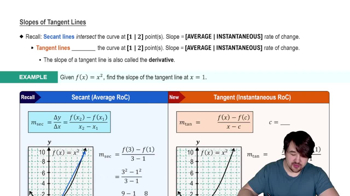
Tangent Lines

A tangent line to a curve at a given point is a straight line that touches the curve at that point without crossing it. The slope of the tangent line is equal to the derivative of the function at that point. This concept is crucial for understanding how functions behave locally around specific values.
추천 영상:
가이드 코스
05:13
Slopes of Tangent Lines

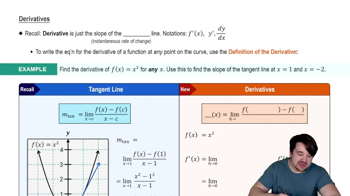
Limit Definition of Derivative

The limit definition of the derivative states that the derivative of a function f at a point a is given by the limit as h approaches zero of the difference quotient (f(a+h) - f(a))/h. This definition is foundational in calculus, as it formalizes the concept of instantaneous rate of change and is used to compute derivatives for various functions.
추천 영상:
가이드 코스
05:43
Definition of the Definite Integral