Ch. 3 - Derivatives
Briggs - Calculus: Early Transcendentals 3rd Edition
Briggs3rd EditionCalculus: Early TranscendentalsISBN: 9780136847243당신이 사용하는 게 아니라요?교과서 변경
3장, 문제 3.R.58

Evaluate and simplify y'.
sin x cos(y−1) = 1/2

검증된 단계별 안내
1
First, identify the given equation: \( y' \cdot \sin(x) \cdot \cos(y - 1) = \frac{1}{2} \). Here, \( y' \) represents the derivative of \( y \) with respect to \( x \).
To isolate \( y' \), divide both sides of the equation by \( \sin(x) \cdot \cos(y - 1) \). This gives: \( y' = \frac{1}{2} \div (\sin(x) \cdot \cos(y - 1)) \).
Simplify the expression for \( y' \) by rewriting the division as a multiplication by the reciprocal: \( y' = \frac{1}{2} \cdot \frac{1}{\sin(x) \cdot \cos(y - 1)} \).
Combine the fractions to express \( y' \) as a single fraction: \( y' = \frac{1}{2 \cdot \sin(x) \cdot \cos(y - 1)} \).
The expression for \( y' \) is now simplified. Ensure that the domain restrictions for \( \sin(x) \) and \( \cos(y - 1) \) are considered, as they cannot be zero.

비슷한 문제에 대한 검증된 영상 답변:

이 영상 해법은 위 문제에 도움이 된다고 튜터들이 추천한 것입니다.
영상 길이:
4m
도움이 되었나요?

주요 개념

질문에 올바르게 답하기 위해 반드시 이해해야 하는 핵심 개념들은 다음과 같습니다.

Implicit Differentiation

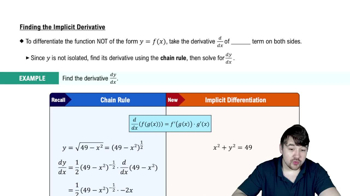
Implicit differentiation is a technique used to differentiate equations where the dependent variable is not isolated on one side. In this case, we have a relationship between x and y given by sin x cos(y−1) = 1/2. By differentiating both sides with respect to x, we can find dy/dx, which represents y'.
추천 영상:
가이드 코스
05:14
Finding The Implicit Derivative

Chain Rule

The chain rule is a fundamental principle in calculus that allows us to differentiate composite functions. When differentiating terms involving y, such as cos(y−1), we apply the chain rule to account for the derivative of the inner function (y−1) with respect to x, which involves dy/dx. This is crucial for correctly finding y'.
추천 영상:
05:02
Intro to the Chain Rule

Trigonometric Identities

Trigonometric identities are equations involving trigonometric functions that hold true for all values of the variables. In this problem, understanding the properties of sine and cosine is essential, especially since we are working with sin x and cos(y−1). These identities can help simplify the expression after differentiation and aid in solving for y'.
추천 영상:
7:17
Verifying Trig Equations as Identities