
Ch. 3 - Derivatives
Briggs - Calculus: Early Transcendentals 3rd Edition
Briggs3rd EditionCalculus: Early TranscendentalsISBN: 9780136847243당신이 사용하는 게 아니라요?교과서 변경
3장, 문제 3.10.13

Evaluate the derivative of the following functions.
f(x) = sin-1 2x

검증된 단계별 안내
1
Step 1: Recognize that \( f(x) = \sin^{-1}(2x) \) is the inverse sine function, also known as arcsine, applied to \( 2x \).
Step 2: Recall the derivative formula for the inverse sine function: \( \frac{d}{dx}[\sin^{-1}(u)] = \frac{1}{\sqrt{1-u^2}} \cdot \frac{du}{dx} \), where \( u \) is a function of \( x \).
Step 3: Identify \( u = 2x \) in this problem, so you need to find \( \frac{du}{dx} \).
Step 4: Differentiate \( u = 2x \) with respect to \( x \), which gives \( \frac{du}{dx} = 2 \).
Step 5: Substitute \( u = 2x \) and \( \frac{du}{dx} = 2 \) into the derivative formula: \( \frac{d}{dx}[\sin^{-1}(2x)] = \frac{1}{\sqrt{1-(2x)^2}} \cdot 2 \).

비슷한 문제에 대한 검증된 영상 답변:

이 영상 해법은 위 문제에 도움이 된다고 튜터들이 추천한 것입니다.
영상 길이:
2m
도움이 되었나요?

주요 개념

질문에 올바르게 답하기 위해 반드시 이해해야 하는 핵심 개념들은 다음과 같습니다.

Derivative

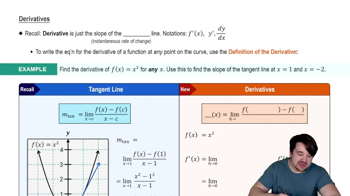
The derivative of a function measures how the function's output value changes as its input value changes. It is defined as the limit of the average rate of change of the function over an interval as the interval approaches zero. In calculus, the derivative is often denoted as f'(x) or df/dx, and it provides critical information about the function's behavior, such as its slope and points of tangency.
추천 영상:

Inverse Trigonometric Functions

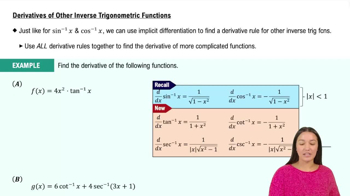
Inverse trigonometric functions, such as sin<sup>-1</sup>(x), are the functions that reverse the action of the standard trigonometric functions. For example, sin<sup>-1</sup>(x) gives the angle whose sine is x. These functions have specific domains and ranges, and their derivatives can be derived using implicit differentiation or known derivative formulas, which are essential for evaluating derivatives involving these functions.
추천 영상:
06:35
Derivatives of Other Inverse Trigonometric Functions

Chain Rule

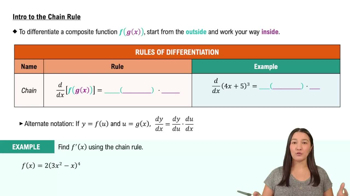
The chain rule is a fundamental technique in calculus used to differentiate composite functions. It states that if a function y = f(g(x)) is composed of two functions, the derivative can be found by multiplying the derivative of the outer function f with the derivative of the inner function g. This rule is particularly useful when dealing with functions like sin<sup>-1</sup>(2x), where the inner function (2x) must be differentiated alongside the outer function (sin<sup>-1</sup>), requiring careful application of the chain rule.
추천 영상:
05:02
Intro to the Chain Rule
관련 실천
교과서 질문

Verifying derivative formulas Verify the following derivative formulas using the Quotient Rule.

d/dx (csc x) = -csc x cot x

276
views
교과서 질문

Using identities Use the identity sin 2x=2 sin x cos x sin 2 to find d/dx (sin 2x). Then use the identity cos 2x = cos² x−sin² x to express the derivative of sin 2x in terms of cos 2x.

421
views
교과서 질문

Orthogonal trajectories Two curves are orthogonal to each other if their tangent lines are perpendicular at each point of intersection (recall that two lines are perpendicular to each other if their slopes are negative reciprocals). A family of curves forms orthogonal trajectories with another family of curves if each curve in one family is orthogonal to each curve in the other family. For example, the parabolas y = cx² form orthogonal trajectories with the family of ellipses x²+2y² = k, where c and k are constants (see figure).

Find dy/dx for each equation of the following pairs. Use the derivatives to explain why the families of curves form orthogonal trajectories. <IMAGE>


y = cx²; x²+2y² = k, where c and k are constants

473
views
교과서 질문

Derivatives Find and simplify the derivative of the following functions.

f(x) = x /x+1

290
views
교과서 질문

27–76. Calculate the derivative of the following functions.

y=(x2+2x+7)8y=\(\left\)(x^2+2x+7\(\right\))^8

326
views
교과서 질문

Calculate the derivative of the following functions. In some cases, it is useful to use the properties of logarithms to simplify the functions before computing f'(x).

f(x) = In(3x + 1)⁴

252
views