Ch. 3 - Derivatives
Briggs - Calculus: Early Transcendentals 3rd Edition
Briggs3rd EditionCalculus: Early TranscendentalsISBN: 9780136847243당신이 사용하는 게 아니라요?교과서 변경
3장, 문제 3.5.72a

Find an equation of the line tangent to the following curves at the given value of x.
y = 4 sin x cos x; x = π/3

검증된 단계별 안내
1
First, understand that the problem requires finding the equation of the tangent line to the curve y = 4 sin x cos x at x = π/3. The tangent line will have the form y = mx + b, where m is the slope at the given point and b is the y-intercept.
To find the slope of the tangent line, we need to compute the derivative of the function y = 4 sin x cos x with respect to x. Use the product rule for differentiation, which states that if you have a function u(x)v(x), its derivative is u'(x)v(x) + u(x)v'(x).
Apply the product rule: Let u(x) = 4 sin x and v(x) = cos x. Then, u'(x) = 4 cos x and v'(x) = -sin x. The derivative of y with respect to x, denoted as dy/dx, is: dy/dx = u'(x)v(x) + u(x)v'(x) = 4 cos x * cos x + 4 sin x * (-sin x).
Simplify the expression for dy/dx: dy/dx = 4 cos^2 x - 4 sin^2 x. This can be further simplified using the trigonometric identity cos(2x) = cos^2 x - sin^2 x, giving dy/dx = 4 cos(2x).
Evaluate the derivative at x = π/3 to find the slope m of the tangent line: m = 4 cos(2 * π/3). Calculate the value of y at x = π/3 using the original function y = 4 sin x cos x, and use these values to find the equation of the tangent line in the form y = mx + b.

비슷한 문제에 대한 검증된 영상 답변:

이 영상 해법은 위 문제에 도움이 된다고 튜터들이 추천한 것입니다.
영상 길이:
7m

주요 개념

질문에 올바르게 답하기 위해 반드시 이해해야 하는 핵심 개념들은 다음과 같습니다.

Tangent Line

A tangent line to a curve at a given point is a straight line that touches the curve at that point without crossing it. The slope of the tangent line is equal to the derivative of the function at that point. This concept is crucial for finding the equation of the tangent line, as it provides both the slope and the point of tangency.
추천 영상:
가이드 코스
05:13
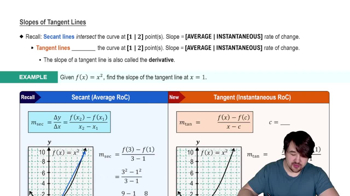
Slopes of Tangent Lines

Derivative

The derivative of a function measures how the function's output changes as its input changes. It is defined as the limit of the average rate of change of the function as the interval approaches zero. In this context, calculating the derivative of the function y = 4 sin x cos x will allow us to find the slope of the tangent line at x = π/3.
추천 영상:

Trigonometric Identities

Trigonometric identities are equations that involve trigonometric functions and are true for all values of the variables involved. In this problem, the identity sin(2x) = 2 sin x cos x can simplify the function y = 4 sin x cos x to y = 2 sin(2x), making it easier to differentiate and evaluate at specific points.
추천 영상:
7:17
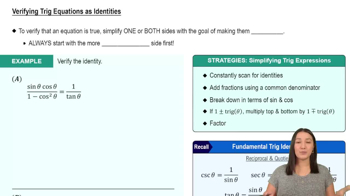
Verifying Trig Equations as Identities
관련 실천
교과서 질문

Vertical tangent lines

a. Determine the points where the curve x+y³−y=1 has a vertical tangent line (see Exercise 60).

367
views

교과서 질문

Highway travel A state patrol station is located on a straight north-south freeway. A patrol car leaves the station at 9:00 A.M. heading north with position function s = f(t) that gives its location in miles t hours after 9:00 A.M. (see figure). Assume s is positive when the car is north of the patrol station. <IMAGE>

a. Determine the average velocity of the car during the first 45 minutes of the trip.

303
views
교과서 질문

Airline travel The following figure shows the position function of an airliner on an out-and-back trip from Seattle to Minneapolis, where s = f(t) is the number of ground miles from Seattle t hours after take-off at 6:00 A.M. The plane returns to Seattle 8.5 hours later at 2:30 P.M. <IMAGE>

a. Calculate the average velocity of the airliner during the first 1.5 hours of the trip (0 ≤ t ≤ 1.5).

302
views
교과서 질문

21–30. Derivatives

a. Use limits to find the derivative function f' for the following functions f.

f(x) = 4x²+1; a= 2,4

178
views
교과서 질문

{Use of Tech} Approximating derivatives Assuming the limit exists, the definition of the derivative f′(a) = lim h→0 f(a + h) − f(a) / h implies that if ℎ is small, then an approximation to f′(a) is given by

f' (a) ≈ f(a+h) - f(a) / h. If ℎ > 0 , then this approximation is called a forward difference quotient; if ℎ < 0 , it is a backward difference quotient. As shown in the following exercises, these formulas are used to approximate f′ at a point when f is a complicated function or when f is represented by a set of data points. <IMAGE>

Let f (x) = √x.

a. Find the exact value of f' (4).

245
views
교과서 질문

13-26 Implicit differentiation Carry out the following steps.

a. Use implicit differentiation to find dy/dx.

sin y = 5x⁴−5; (1, π)

237
views