

Piston compression A piston is seated at the top of a cylindrical chamber with radius 5 cm when it starts moving into the chamber at a constant speed of 3 cm/s (see figure). What is the rate of change of the volume of the cylinder when the piston is 2 cm from the base of the chamber? <IMAGE>
Ch. 3 - Derivatives
3장, 문제 3.9.88
Find the following higher-order derivatives.
d²/dx² (In(x² + 1))
검증된 단계별 안내1
Step 1: Identify the function for which we need to find the second derivative. The function is \( f(x) = \ln(x^2 + 1) \).
Step 2: Find the first derivative of \( f(x) \). Use the chain rule: \( \frac{d}{dx}[\ln(u)] = \frac{1}{u} \cdot \frac{du}{dx} \), where \( u = x^2 + 1 \). Thus, \( \frac{d}{dx}[\ln(x^2 + 1)] = \frac{1}{x^2 + 1} \cdot \frac{d}{dx}[x^2 + 1] \).
Step 3: Differentiate \( x^2 + 1 \) with respect to \( x \). The derivative is \( \frac{d}{dx}[x^2 + 1] = 2x \). Substitute this back into the expression from Step 2 to get the first derivative: \( \frac{d}{dx}[\ln(x^2 + 1)] = \frac{2x}{x^2 + 1} \).
Step 4: Find the second derivative by differentiating the first derivative \( \frac{2x}{x^2 + 1} \) with respect to \( x \). Use the quotient rule: \( \frac{d}{dx}[\frac{v}{w}] = \frac{w \cdot \frac{dv}{dx} - v \cdot \frac{dw}{dx}}{w^2} \), where \( v = 2x \) and \( w = x^2 + 1 \).
Step 5: Calculate \( \frac{dv}{dx} = 2 \) and \( \frac{dw}{dx} = 2x \). Substitute these into the quotient rule formula to find the second derivative: \( \frac{d^2}{dx^2}[\ln(x^2 + 1)] = \frac{(x^2 + 1) \cdot 2 - 2x \cdot 2x}{(x^2 + 1)^2} \). Simplify the expression to complete the calculation.

비슷한 문제에 대한 검증된 영상 답변:
이 영상 해법은 위 문제에 도움이 된다고 튜터들이 추천한 것입니다.
영상 길이:
6m도움이 되었나요?
주요 개념
질문에 올바르게 답하기 위해 반드시 이해해야 하는 핵심 개념들은 다음과 같습니다.
Higher-Order Derivatives
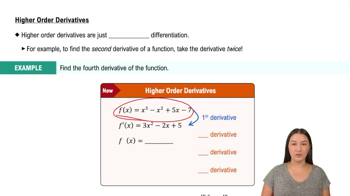
Higher-order derivatives refer to the derivatives of a function taken multiple times. The first derivative gives the rate of change of the function, the second derivative provides information about the curvature or concavity, and so on. In this context, finding the second derivative involves differentiating the function twice with respect to the variable.
추천 영상:
Higher Order Derivatives
Chain Rule
The chain rule is a fundamental differentiation technique used when differentiating composite functions. It states that the derivative of a composite function is the derivative of the outer function evaluated at the inner function, multiplied by the derivative of the inner function. This rule is essential for correctly differentiating functions like In(x² + 1), where x² + 1 is the inner function.
추천 영상:
Intro to the Chain Rule
Natural Logarithm Function
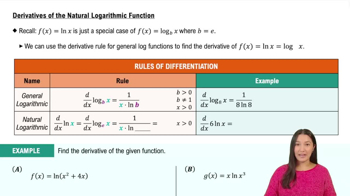
The natural logarithm function, denoted as In(x), is the logarithm to the base e, where e is approximately 2.71828. It is important in calculus because it has unique properties, such as its derivative being 1/x. Understanding how to differentiate the natural logarithm, especially in the context of composite functions, is crucial for solving the given problem.
추천 영상:
Derivative of the Natural Logarithmic Function
관련 실천
교과서 질문
291
views
교과서 질문
Initial velocity Suppose a baseball is thrown vertically upward from the ground with an initial velocity of v0ft/s Its height above the ground after t seconds is given by s(t) = -16t²+v0t. Determine the initial velocity of the ball if it reaches a high point of 128 ft.
312
views
교과서 질문
67–78. Derivatives of inverse functions Consider the following functions (on the given interval, if specified). Find the derivative of the inverse function.
f(x) = 3x-4
191
views
교과서 질문
27–76. Calculate the derivative of the following functions.
423
views
교과서 질문
Find y'' for the following functions.
y = x sin x
368
views
교과서 질문
Find (f^−1)′(3), where f(x)=x³+x+1.
203
views
