Ch. 3 - Derivatives
Briggs - Calculus: Early Transcendentals 3rd Edition
Briggs3rd EditionCalculus: Early TranscendentalsISBN: 9780136847243당신이 사용하는 게 아니라요?교과서 변경
3장, 문제 3.11.30

Parabolic motion An arrow is shot into the air and moves along the parabolic path y=x(50−x) (see figure). The horizontal component of velocity is always 30 ft/s. What is the vertical component of velocity when (a) x=10 and (b) x=40? <IMAGE>

검증된 단계별 안내
1
First, understand that the path of the arrow is given by the equation y = x(50 - x). This is a parabolic equation representing the vertical position y as a function of the horizontal position x.
To find the vertical component of velocity, we need to determine the derivative of y with respect to time t, which is dy/dt. However, y is given as a function of x, so we will use the chain rule: dy/dt = (dy/dx) * (dx/dt).
The horizontal component of velocity is given as dx/dt = 30 ft/s. This is constant throughout the motion.
Next, find dy/dx by differentiating y = x(50 - x) with respect to x. This gives dy/dx = 50 - 2x.
Now, substitute dy/dx and dx/dt into the chain rule expression: dy/dt = (50 - 2x) * 30. This expression gives the vertical component of velocity as a function of x. Evaluate this expression for (a) x = 10 and (b) x = 40 to find the vertical component of velocity at these points.

비슷한 문제에 대한 검증된 영상 답변:

이 영상 해법은 위 문제에 도움이 된다고 튜터들이 추천한 것입니다.
영상 길이:
4m

주요 개념

질문에 올바르게 답하기 위해 반드시 이해해야 하는 핵심 개념들은 다음과 같습니다.

Parabolic Motion

Parabolic motion refers to the trajectory of an object that is influenced by gravity, resulting in a curved path. In this case, the motion of the arrow follows a parabolic equation, which describes how the vertical position (y) changes with respect to the horizontal position (x). Understanding this concept is crucial for analyzing the motion of projectiles and determining their velocity components.
추천 영상:
가이드 코스
06:29
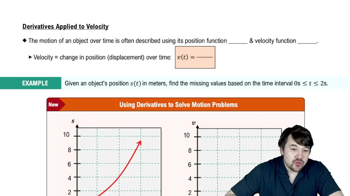
Derivatives Applied To Velocity

Velocity Components

Velocity is a vector quantity that has both magnitude and direction. In projectile motion, the total velocity can be broken down into horizontal and vertical components. The horizontal component remains constant (30 ft/s in this case), while the vertical component changes due to gravitational acceleration. Calculating these components at specific points along the trajectory is essential for understanding the arrow's motion.
추천 영상:
가이드 코스
06:29
Derivatives Applied To Velocity

Differentiation

Differentiation is a fundamental concept in calculus that involves finding the rate at which a function changes at any given point. In the context of this problem, differentiating the parabolic equation y = x(50 - x) with respect to x allows us to determine the vertical component of velocity, which is the derivative of the height with respect to time. This mathematical tool is vital for analyzing motion and finding instantaneous rates.
추천 영상:
가이드 코스
05:53
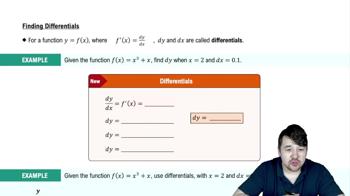
Finding Differentials