Ch. 3 - Derivatives
Briggs - Calculus: Early Transcendentals 3rd Edition
Briggs3rd EditionCalculus: Early TranscendentalsISBN: 9780136847243당신이 사용하는 게 아니라요?교과서 변경
3장, 문제 18b

Position, velocity, and acceleration Suppose the position of an object moving horizontally along a line after t seconds is given by the following functions s = f(t), where s is measured in feet, with s > 0 corresponding to positions right of the origin.
b. Find and graph the velocity function. When is the object stationary, moving to the right, and moving to the left?
f(t) = 18t-3t²; 0 ≤ t ≤ 8

검증된 단계별 안내
1
Step 1: Understand the relationship between position, velocity, and acceleration. The position function s = f(t) describes the location of an object at time t. The velocity function v(t) is the derivative of the position function, representing the rate of change of position with respect to time.
Step 2: Differentiate the position function f(t) = 18t - 3t^2 to find the velocity function v(t). Use the power rule for differentiation: if f(t) = at^n, then f'(t) = n*at^(n-1).
Step 3: Apply the power rule to each term in f(t). The derivative of 18t is 18, and the derivative of -3t^2 is -6t. Therefore, the velocity function is v(t) = 18 - 6t.
Step 4: Determine when the object is stationary by setting the velocity function equal to zero and solving for t. This will give the time(s) when the object is not moving.
Step 5: Analyze the sign of the velocity function to determine when the object is moving to the right (v(t) > 0) and moving to the left (v(t) < 0). This involves solving inequalities based on the velocity function.

비슷한 문제에 대한 검증된 영상 답변:

이 영상 해법은 위 문제에 도움이 된다고 튜터들이 추천한 것입니다.
영상 길이:
7m

주요 개념

질문에 올바르게 답하기 위해 반드시 이해해야 하는 핵심 개념들은 다음과 같습니다.

Position Function

The position function, denoted as s = f(t), describes the location of an object at any given time t. In this case, the function f(t) = 18t - 3t² represents the position of the object in feet. Understanding this function is crucial as it provides the basis for determining both velocity and acceleration, which are derived from the position function.
추천 영상:
가이드 코스
5:20
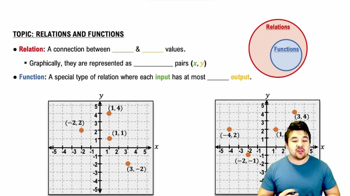
Relations and Functions

Velocity Function

The velocity function is the first derivative of the position function with respect to time, represented as v(t) = f'(t). It indicates the rate of change of position, showing how fast and in which direction the object is moving. For the given position function, calculating the derivative will yield the velocity function, which can then be analyzed to determine when the object is stationary (v(t) = 0), moving to the right (v(t) > 0), or moving to the left (v(t) < 0).
추천 영상:
가이드 코스
06:29
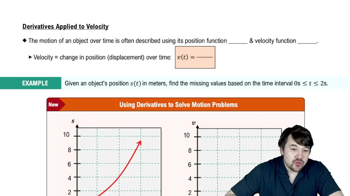
Derivatives Applied To Velocity

Graphing Functions

Graphing functions involves plotting the values of a function on a coordinate system to visualize its behavior. For the velocity function derived from the position function, the graph will help identify key features such as intercepts, maxima, and minima. Analyzing the graph allows for a clear understanding of the object's motion over time, including when it changes direction or comes to a stop.
추천 영상:
가이드 코스
5:53
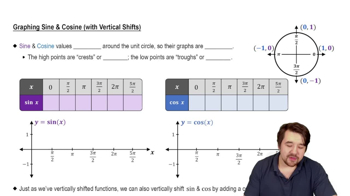
Graph of Sine and Cosine Function