Ch. 3 - Derivatives
Briggs - Calculus: Early Transcendentals 3rd Edition
Briggs3rd EditionCalculus: Early TranscendentalsISBN: 9780136847243당신이 사용하는 게 아니라요?교과서 변경
3장, 문제 12a

Shrinking square The sides of a square decrease in length at a rate of 1 m/s.
a. At what rate is the area of the square changing when the sides are 5 m long?

검증된 단계별 안내
1
Identify the relationship between the side length of the square and its area. The area \( A \) of a square with side length \( s \) is given by \( A = s^2 \).
Recognize that the problem involves rates of change, which suggests using derivatives. We need to find \( \frac{dA}{dt} \), the rate of change of the area with respect to time.
Apply the chain rule to differentiate the area with respect to time: \( \frac{dA}{dt} = \frac{d}{dt}(s^2) = 2s \frac{ds}{dt} \).
Substitute the given values into the differentiated equation. We know \( \frac{ds}{dt} = -1 \) m/s (since the side is decreasing) and \( s = 5 \) m.
Calculate \( \frac{dA}{dt} \) using the substituted values: \( \frac{dA}{dt} = 2 \times 5 \times (-1) \). This will give the rate at which the area is changing when the sides are 5 m long.

비슷한 문제에 대한 검증된 영상 답변:

이 영상 해법은 위 문제에 도움이 된다고 튜터들이 추천한 것입니다.
영상 길이:
3m
도움이 되었나요?

주요 개념

질문에 올바르게 답하기 위해 반드시 이해해야 하는 핵심 개념들은 다음과 같습니다.

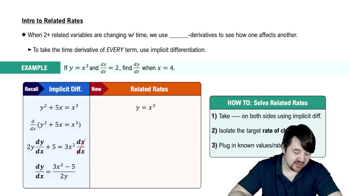
Related Rates

Related rates involve finding the rate at which one quantity changes in relation to another. In this problem, we need to determine how the area of the square changes as the length of its sides decreases. This requires applying the chain rule from calculus to relate the rates of change of the side length and the area.
추천 영상:
가이드 코스
04:16
Intro To Related Rates

Area of a Square

The area of a square is calculated using the formula A = s², where s is the length of a side. As the side length changes, the area will also change. Understanding this relationship is crucial for determining how the area is affected by the rate at which the side length is decreasing.
추천 영상:
가이드 코스
07:59
Estimating the Area Under a Curve Using Left Endpoints

Chain Rule

The chain rule is a fundamental principle in calculus used to differentiate composite functions. In this context, it allows us to express the rate of change of the area with respect to time by relating it to the rate of change of the side length. This is essential for solving the problem and finding the rate at which the area is changing.
추천 영상:
05:02
Intro to the Chain Rule