
Ch. 3 - Derivatives
Briggs - Calculus: Early Transcendentals 3rd Edition
Briggs3rd EditionCalculus: Early TranscendentalsISBN: 9780136847243당신이 사용하는 게 아니라요?교과서 변경
3장, 문제 23e

Suppose a stone is thrown vertically upward from the edge of a cliff on Earth with an initial velocity of 32 ft/s from a height of 48 ft above the ground. The height (in feet) of the stone above the ground t seconds after it is thrown is s(t) = -16t2 + 32t + 48.
With what velocity does the stone strike the ground?

검증된 단계별 안내
1
Step 1: Understand the problem. We need to find the velocity of the stone when it strikes the ground. The height function is given by s(t) = -16t^2 + 32t + 48, where s(t) is the height in feet and t is the time in seconds.
Step 2: Determine when the stone hits the ground. This occurs when s(t) = 0. Solve the equation -16t^2 + 32t + 48 = 0 to find the time t when the stone reaches the ground.
Step 3: Use the quadratic formula to solve for t. The quadratic formula is t = (-b ± √(b^2 - 4ac)) / (2a), where a = -16, b = 32, and c = 48.
Step 4: Once you have the value of t when the stone hits the ground, find the velocity at that time. The velocity function v(t) is the derivative of the height function s(t).
Step 5: Differentiate s(t) to find v(t). The derivative of s(t) = -16t^2 + 32t + 48 is v(t) = ds/dt = -32t + 32. Substitute the value of t from Step 3 into v(t) to find the velocity when the stone strikes the ground.

비슷한 문제에 대한 검증된 영상 답변:

이 영상 해법은 위 문제에 도움이 된다고 튜터들이 추천한 것입니다.
영상 길이:
6m
도움이 되었나요?

주요 개념

질문에 올바르게 답하기 위해 반드시 이해해야 하는 핵심 개념들은 다음과 같습니다.

Quadratic Functions

The height of the stone is modeled by a quadratic function, s(t) = -16t² + 32t + 48. Quadratic functions are polynomial functions of degree two, characterized by their parabolic shape. Understanding how to analyze and manipulate these functions is crucial for determining the stone's height at any given time and finding when it reaches the ground.
추천 영상:
6:04
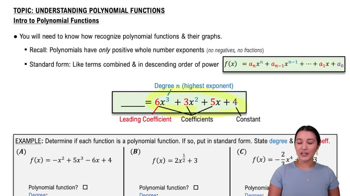
Introduction to Polynomial Functions

Velocity and Acceleration

Velocity is the rate of change of position with respect to time, and it can be derived from the height function by taking its first derivative, s'(t). In this context, the stone's velocity will change due to gravitational acceleration, which is represented by the coefficient of the t² term in the height equation. Recognizing how to compute and interpret velocity is essential for determining how fast the stone is moving when it strikes the ground.
추천 영상:
가이드 코스
06:15
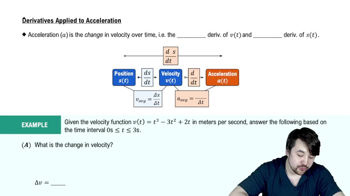
Derivatives Applied To Acceleration

Roots of a Function

Finding the roots of the height function s(t) is necessary to determine when the stone hits the ground, which occurs when s(t) = 0. The roots can be found using the quadratic formula or factoring, and they represent the time(s) at which the height of the stone is zero. This concept is fundamental in solving problems involving motion and understanding the behavior of quadratic equations.
추천 영상:
가이드 코스
7:24
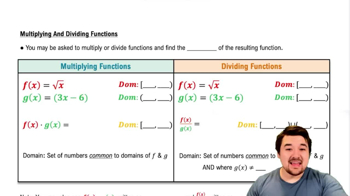
Multiplying & Dividing Functions
관련 실천
교과서 질문

Suppose a stone is thrown vertically upward from the edge of a cliff on Earth with an initial velocity of 19.6 m/s from a height of 24.5 m above the ground. The height (in meters) of the stone above the ground t seconds after it is thrown is s(t) = -4.9t2 + 19.6t + 24.5.

On what intervals is the speed increasing?

305
views
교과서 질문

Suppose a stone is thrown vertically upward from the edge of a cliff on Earth with an initial velocity of 32 ft/s from a height of 48 ft above the ground. The height (in feet) of the stone above the ground t seconds after it is thrown is s(t) = -16t2 + 32t + 48.

Determine the velocity v of the stone after t seconds.

318
views
교과서 질문

Once Kate’s kite reaches a height of 50 ft (above her hands), it rises no higher but drifts due east in a wind blowing 5 ft/s. How fast is the string running through Kate’s hands at the moment when she has released 120 ft of string?

226
views
교과서 질문

Suppose a stone is thrown vertically upward from the edge of a cliff on Earth with an initial velocity of 32 ft/s from a height of 48 ft above the ground. The height (in feet) of the stone above the ground t seconds after it is thrown is s(t) = -16t2 + 32t + 48.

On what intervals is the speed increasing?

199
views
교과서 질문

5–24. For each of the following composite functions, find an inner function u=g(x) and an outer function y=f(u) such that y=f(g(x)). Then calculate dy/dx.

y = tan 5x²

251
views
교과서 질문

Throwing a stone Suppose a stone is thrown vertically upward from the edge of a cliff on Earth with an initial velocity of 32 ft/s from a height of 48 ft above the ground. The height (in feet) of the stone above the ground t seconds after it is thrown is s(t)=16t2+32t+48s(t)=-16t^2+32t+48 .

d. When does the stone strike the ground?

627
views