Ch. 3 - Derivatives
Briggs - Calculus: Early Transcendentals 3rd Edition
Briggs3rd EditionCalculus: Early TranscendentalsISBN: 9780136847243당신이 사용하는 게 아니라요?교과서 변경
3장, 문제 3.6.24c

Suppose a stone is thrown vertically upward from the edge of a cliff on Earth with an initial velocity of 19.6 m/s from a height of 24.5 m above the ground. The height (in meters) of the stone above the ground t seconds after it is thrown is s(t) = -4.9t²+19.6t+24.5.
c. What is the height of the stone at the highest point?

검증된 단계별 안내
1
To find the height of the stone at the highest point, we need to determine when the stone reaches its maximum height. This occurs when the velocity of the stone is zero.
The velocity of the stone is the derivative of the height function s(t) with respect to time t. So, we need to find the derivative s'(t).
Calculate the derivative: s'(t) = d/dt(-4.9t² + 19.6t + 24.5). Using the power rule, s'(t) = -9.8t + 19.6.
Set the derivative equal to zero to find the time t at which the stone reaches its maximum height: -9.8t + 19.6 = 0. Solve for t.
Once you have the value of t, substitute it back into the original height function s(t) = -4.9t² + 19.6t + 24.5 to find the height of the stone at the highest point.

비슷한 문제에 대한 검증된 영상 답변:

이 영상 해법은 위 문제에 도움이 된다고 튜터들이 추천한 것입니다.
영상 길이:
4m
도움이 되었나요?

주요 개념

질문에 올바르게 답하기 위해 반드시 이해해야 하는 핵심 개념들은 다음과 같습니다.

Quadratic Functions

The height of the stone is modeled by a quadratic function, which is a polynomial of degree two. In this case, the function s(t) = -4.9t² + 19.6t + 24.5 represents a parabola that opens downward due to the negative coefficient of the t² term. Understanding the properties of quadratic functions, such as their vertex and axis of symmetry, is essential for determining the maximum height of the stone.
추천 영상:
6:04
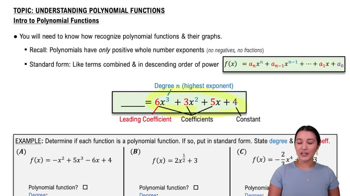
Introduction to Polynomial Functions

Vertex of a Parabola

The highest point of a downward-opening parabola, like the one described by the height function, is called the vertex. The vertex can be found using the formula t = -b/(2a), where a and b are the coefficients from the quadratic equation. This point gives the time at which the stone reaches its maximum height, which is crucial for solving the problem.
추천 영상:
7:42
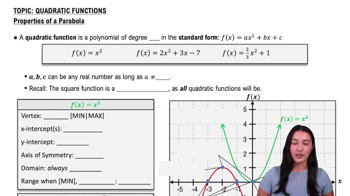
Properties of Parabolas

Maximum Value of a Function

To find the maximum height of the stone, we need to evaluate the height function at the time found from the vertex calculation. The maximum value of the function s(t) corresponds to the height of the stone at its peak. This involves substituting the time back into the original height equation to find the specific height at that moment.
추천 영상:
가이드 코스
06:37
Average Value of a Function
관련 실천
교과서 질문

Derivatives of inverse functions from a table Use the following tables to determine the indicated derivatives or state that the derivative cannot be determined. <IMAGE>

c. (f^-1)'(1)

167
views

교과서 질문

{Use of Tech} Spring runoff The flow of a small stream is monitored for 90 days between May 1 and August 1. The total water that flows past a gauging station is given by v(t) = <matrix 2x2> where V is measured in cubic feet and t is measured in days, with t=0 corresponding to May 1.

c. Describe the flow of the stream over the 3-month period. Specifically, when is the flow rate a maximum?

218
views
교과서 질문

Another way to approximate derivatives is to use the centered difference quotient: f' (a) ≈ f(a+h) - f(a- h) / 2h. Again, consider f(x) = √x.

c. Explain why it is not necessary to use negative values of h in the table of part (b).

361
views
교과서 질문

Derivatives of sin^n x Calculate the following derivatives using the Product Rule.

c. d/dx (sin⁴ x)

299
views
교과서 질문

Highway travel A state patrol station is located on a straight north-south freeway. A patrol car leaves the station at 9:00 A.M. heading north with position function s = f(t) that gives its location in miles t hours after 9:00 A.M. (see figure). Assume s is positive when the car is north of the patrol station. <IMAGE>

c. Find the average velocity of the car over the interval [1.75, 2.25]. Estimate the velocity of the car at 11:00 A.M. and determine the direction in which the patrol car is moving.

239
views
교과서 질문

Vibrations of a spring Suppose an object of mass m is attached to the end of a spring hanging from the ceiling. The mass is at its equilibrium position y=0y=0 when the mass hangs at rest. Suppose you push the mass to a position y0y_0 units above its equilibrium position and release it. As the mass oscillates up and down (neglecting any friction in the system), the position y of the mass after t seconds is y=y0cos(tkm)y=y_0\(\cos\]\left\)(t\(\sqrt{\frac{k}{m}\)}\(\right\)), where k>0k>0 is a constant measuring the stiffness of the spring (the larger the value of kk, the stiffer the spring) and yy is positive in the upward direction.

Use equation (4) to answer the following questions.

c. How would the velocity be affected if the experiment were repeated with a spring having four times the stiffness (kk is increased by a factor of 44)?

394
views