Ch. 3 - Derivatives
Briggs - Calculus: Early Transcendentals 3rd Edition
Briggs3rd EditionCalculus: Early TranscendentalsISBN: 9780136847243당신이 사용하는 게 아니라요?교과서 변경
3장, 문제 3.8.42a

Surface area of a cone The lateral surface area of a cone of radius r and height h (the surface area excluding the base) is A = πr√r²+h².
a. Find dr/dh for a cone with a lateral surface area of A=1500π.

검증된 단계별 안내
1
Start with the formula for the lateral surface area of a cone: A = πr√(r² + h²). We are given that A = 1500π.
Set up the equation 1500π = πr√(r² + h²). Divide both sides by π to simplify: 1500 = r√(r² + h²).
To find dr/dh, we need to differentiate both sides of the equation with respect to h. First, express r in terms of h if possible, or use implicit differentiation.
Differentiate the equation 1500 = r√(r² + h²) with respect to h. Use the product rule and chain rule as necessary. The derivative of the left side is 0 since it's a constant.
Solve the resulting equation for dr/dh. This will involve isolating dr/dh on one side of the equation, which may require algebraic manipulation and simplification.

비슷한 문제에 대한 검증된 영상 답변:

이 영상 해법은 위 문제에 도움이 된다고 튜터들이 추천한 것입니다.
영상 길이:
6m

주요 개념

질문에 올바르게 답하기 위해 반드시 이해해야 하는 핵심 개념들은 다음과 같습니다.

Lateral Surface Area of a Cone

The lateral surface area of a cone is the area of the cone's curved surface, excluding the base. It is calculated using the formula A = πr√(r² + h²), where r is the radius and h is the height of the cone. Understanding this formula is essential for solving problems related to the surface area of cones.
추천 영상:
09:07
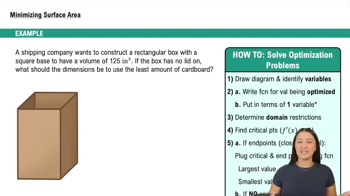
Example 1: Minimizing Surface Area

Implicit Differentiation

Implicit differentiation is a technique used to differentiate equations where the dependent and independent variables are not isolated. In this context, it allows us to find the rate of change of one variable with respect to another, such as dr/dh, without explicitly solving for one variable in terms of the other. This is particularly useful when dealing with relationships defined by equations like the surface area of a cone.
추천 영상:
가이드 코스
05:14
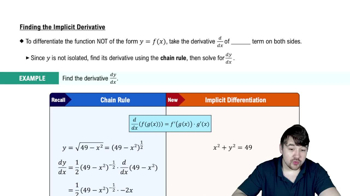
Finding The Implicit Derivative

Chain Rule

The chain rule is a fundamental principle in calculus used to differentiate composite functions. It states that if a variable y depends on u, which in turn depends on x, then the derivative of y with respect to x can be found by multiplying the derivative of y with respect to u by the derivative of u with respect to x. This rule is crucial for finding derivatives like dr/dh when multiple variables are involved.
추천 영상:
05:02
Intro to the Chain Rule
관련 실천
교과서 질문

Volume of a torus The volume of a torus (doughnut or bagel) with an inner radius of a and an outer radius of b is V=π²(b+a)(b−a)²/4.

a. Find db/da for a torus with a volume of 64π².

368
views

교과서 질문

A woman attached to a bungee cord jumps from a bridge that is 30 m above a river. Her height in meters above the river t seconds after the jump is y(t) = 15(1+e-t cos t), for t ≥ 0.

Determine her velocity at t = 1 and t = 3. 

278
views
교과서 질문

Comparing velocities Two stones are thrown vertically upward, each with an initial velocity of 48 ft/s at time t=0. One stone is thrown from the edge of a bridge that is 32 feet above the ground, and the other stone is thrown from ground level. The height above the ground of the stone thrown from the bridge after t seconds is f(t) = − 16t²+48t+32. and the height of the stone thrown from the ground after t seconds is g(t) = −16t²+48t.

a. Show that the stones reach their high points at the same time.

304
views
교과서 질문

Vertical tangent lines If a function f is continuous at a and lim x→a| f′(x)|=∞, then the curve y=f(x) has a vertical tangent line at a, and the equation of the tangent line is x=a. If a is an endpoint of a domain, then the appropriate one-sided derivative (Exercises 71–72) is used. Use this information to answer the following questions.

73. {Use of Tech} Graph the following functions and determine the location of the vertical tangent lines.

a. f(x) = (x-2)^1/3

353
views
교과서 질문

Derivatives and tangent lines

a. For the following functions and values of a, find f′(a).

f(x) = √3x; a= 12

184
views
교과서 질문

13-26 Implicit differentiation Carry out the following steps.

a. Use implicit differentiation to find dy/dx.

tan xy = x+y; (0,0)

222
views