Ch. 3 - Derivatives
Briggs - Calculus: Early Transcendentals 3rd Edition
Briggs3rd EditionCalculus: Early TranscendentalsISBN: 9780136847243당신이 사용하는 게 아니라요?교과서 변경
3장, 문제 71b

The right-sided and left-sided derivatives of a function at a point aa are given by f+(a)=limh0+f(a+h)f(a)hf_{+}^{\(\prime\)}\(\left\)(a\(\right\))={\(\displaystyle\]\lim\)_{h\(\to\)0^{+}}{\(\frac{f(a+h)-f(a)}{h}\)}} and f(a)=limh0f(a+h)f(a)hf_{-}^{\(\prime\)}\(\left\)(a\(\right\))={\(\displaystyle\]\lim\)_{h\(\to\)0^{-}}{\(\frac{f(a+h)-f(a)}{h}\)}}, respectively, provided these limits exist. The derivative f(a)f^{\(\prime\)}\(\left\)(a\(\right\)) exists if and only if f+(a)=f(a)f_{+}^{\(\prime\)}\(\left\)(a\(\right\))=f_{-}^{\(\prime\)}\(\left\)(a\(\right\)).
Compute f+(a)f_{+}^{\(\prime\)}\(\left\)(a\(\right\)) and f(a)f_{-}^{\(\prime\)}\(\left\)(a\(\right\)) at the given point aa.
f(x)=x2f\(\left\)(x\(\right\))=\(\left\)|x-2\(\right\)|; a=2a=2

검증된 단계별 안내
1
Identify the function given: \( f(x) = |x - 2| \) and the point \( a = 2 \).
To find the right-sided derivative \( f_{+}^{\prime}(2) \), consider \( h \to 0^{+} \). For \( x > 2 \), \( f(x) = x - 2 \). Thus, \( f(2 + h) = (2 + h) - 2 = h \).
Compute the right-sided derivative: \( f_{+}^{\prime}(2) = \lim_{h \to 0^{+}} \frac{f(2 + h) - f(2)}{h} = \lim_{h \to 0^{+}} \frac{h - 0}{h} = \lim_{h \to 0^{+}} 1 \).
To find the left-sided derivative \( f_{-}^{\prime}(2) \), consider \( h \to 0^{-} \). For \( x < 2 \), \( f(x) = 2 - x \). Thus, \( f(2 + h) = 2 - (2 + h) = -h \).
Compute the left-sided derivative: \( f_{-}^{\prime}(2) = \lim_{h \to 0^{-}} \frac{f(2 + h) - f(2)}{h} = \lim_{h \to 0^{-}} \frac{-h - 0}{h} = \lim_{h \to 0^{-}} -1 \).

비슷한 문제에 대한 검증된 영상 답변:

이 영상 해법은 위 문제에 도움이 된다고 튜터들이 추천한 것입니다.
영상 길이:
5m
도움이 되었나요?

주요 개념

질문에 올바르게 답하기 위해 반드시 이해해야 하는 핵심 개념들은 다음과 같습니다.

Right-sided and Left-sided Derivatives

Right-sided and left-sided derivatives are limits that describe the behavior of a function as it approaches a specific point from the right or left, respectively. The right-sided derivative at a point 'a' is defined as the limit of the difference quotient as 'h' approaches 0 from the positive side, while the left-sided derivative is defined similarly but approaches from the negative side. These derivatives help determine the function's behavior at points where it may not be differentiable.
추천 영상:
05:50
One-Sided Limits

Existence of the Derivative

The derivative of a function at a point exists if and only if the right-sided and left-sided derivatives at that point are equal. This condition ensures that the function has a well-defined tangent at that point, indicating smoothness and continuity. If the two derivatives are not equal, the function may have a corner or cusp, making it non-differentiable at that point.
추천 영상:
03:07
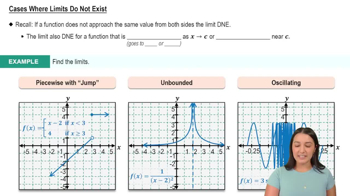
Cases Where Limits Do Not Exist

Absolute Value Function

The absolute value function, denoted as f(x) = |x - 2|, represents the distance of 'x' from 2 on the real number line. This function is piecewise defined, resulting in a V-shaped graph with a vertex at x = 2. Understanding the behavior of this function is crucial for calculating its derivatives, especially at the point where it changes direction, which is where the left-sided and right-sided derivatives need to be evaluated.
추천 영상:
가이드 코스
06:37
Average Value of a Function
관련 실천
교과서 질문

Find f′(x), f′′(x), and f′′′(x) for the following functions.

f(x) = (x2 - 7x - 8) / (x + 1)

291
views

교과서 질문

The following equations implicitly define one or more functions.

c. Use the functions found in part (b) to graph the given equation.

y² = x²(4 − x) / 4 + x (right strophoid)

209
views
교과서 질문

The right-sided and left-sided derivatives of a function at a point aa are given by f+(a)=limh0+f(a+h)f(a)hf_{+}^{\(\prime\)}\(\left\)(a\(\right\))={\(\displaystyle\]\lim\)_{h\(\to\)0^{+}}{\(\frac{f(a+h)-f(a)}{h}\)}} and f(a)=limh0f(a+h)f(a)hf_{-}^{\(\prime\)}\(\left\)(a\(\right\))={\(\displaystyle\]\lim\)_{h\(\to\)0^{-}}{\(\frac{f(a+h)-f(a)}{h}\)}}, respectively, provided these limits exist. The derivative f(a)f^{\(\prime\)}\(\left\)(a\(\right\)) exists if and only if f+(a)=f(a)f_{+}^{\(\prime\)}\(\left\)(a\(\right\))=f_{-}^{\(\prime\)}\(\left\)(a\(\right\)).

Compute f+(a)f_{+}^{\(\prime\)}\(\left\)(a\(\right\)) and f(a)f_{-}^{\(\prime\)}\(\left\)(a\(\right\)) at the given point aa.

f(x)={4x2 if x12x+1 if x>1f(x)=\(\begin{cases}\)4-x^2~\(\text{if}\)~x\(\leq{1}\)\\2x+1~\(\text{if}\)~x\(\gt{1}\]\end{cases}\); a=1a=1

252
views
교과서 질문

The following equations implicitly define one or more functions.

b. Solve the given equation for y to identify the implicitly defined functions y=f₁(x), y = f₂(x), ….

y² = x²(4 − x) / 4 + x (right strophoid)

375
views
교과서 질문

Calculate the derivative of the following functions.

y = (p+3)² sin p²

339
views
교과서 질문

First and second derivatives Find f′(x),f′′(x).

f(x) = x/x+2

404
views