Ch. 3 - Derivatives
Briggs - Calculus: Early Transcendentals 3rd Edition
Briggs3rd EditionCalculus: Early TranscendentalsISBN: 9780136847243당신이 사용하는 게 아니라요?교과서 변경
3장, 문제 3.10.80a

Tracking a dive A biologist standing at the bottom of an 80-foot vertical cliff watches a peregrine falcon dive from the top of the cliff at a 45° angle from the horizontal (see figure). <IMAGE>


a. Express the angle of elevation θ from the biologist to the falcon as a function of the height h of the bird above the ground. (Hint: The vertical distance between the top of the cliff and the falcon is 80−h.)

검증된 단계별 안내
1
Identify the right triangle formed by the cliff, the horizontal distance from the biologist to the falcon, and the line of sight from the biologist to the falcon. The height of the triangle is the vertical distance from the biologist to the falcon, which is 80 - h.
Recognize that the angle of elevation θ is the angle between the horizontal line from the biologist and the line of sight to the falcon.
Use the tangent function, which relates the angle of elevation θ to the opposite side (80 - h) and the adjacent side (horizontal distance x) of the right triangle: tan(θ) = (80 - h) / x.
Since the falcon dives at a 45° angle from the horizontal, the horizontal distance x is equal to the vertical distance from the top of the cliff to the falcon, which is also 80 - h.
Substitute x = 80 - h into the tangent function: tan(θ) = (80 - h) / (80 - h) = 1. Therefore, θ = arctan(1), which simplifies to θ = 45°.

비슷한 문제에 대한 검증된 영상 답변:

이 영상 해법은 위 문제에 도움이 된다고 튜터들이 추천한 것입니다.
영상 길이:
2m
도움이 되었나요?

주요 개념

질문에 올바르게 답하기 위해 반드시 이해해야 하는 핵심 개념들은 다음과 같습니다.

Trigonometric Functions

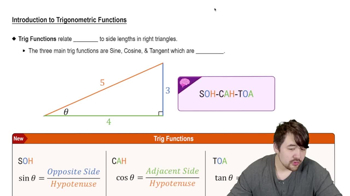
Trigonometric functions, such as sine, cosine, and tangent, relate the angles of a triangle to the lengths of its sides. In this context, the angle of elevation θ can be expressed using the tangent function, which is the ratio of the opposite side (the height of the falcon above the ground) to the adjacent side (the horizontal distance from the biologist to the falcon). Understanding these functions is essential for solving problems involving angles and distances.
추천 영상:
가이드 코스
6:04
Introduction to Trigonometric Functions

Angle of Elevation

The angle of elevation is the angle formed by the horizontal line and the line of sight to an object above that line. In this scenario, the biologist observes the falcon diving, and the angle of elevation θ can be calculated based on the height of the falcon above the ground. This concept is crucial for determining how the height of the falcon changes the angle from the observer's perspective.
추천 영상:
8:22
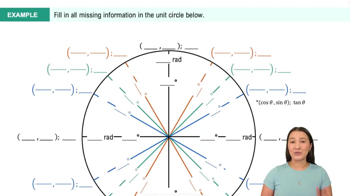
Trig Values in Quadrants II, III, & IV Example 2

Vertical and Horizontal Distances

In this problem, the vertical distance is the height of the falcon above the ground, while the horizontal distance is the distance from the biologist to the point directly below the falcon. The relationship between these distances is key to forming a right triangle, which allows the use of trigonometric functions to express the angle of elevation as a function of the falcon's height. Understanding these distances is vital for applying trigonometry effectively.
추천 영상:
가이드 코스
06:47
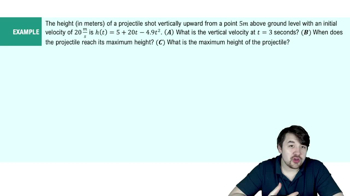
Derivatives Applied To Velocity Example 1