Ch. 3 - Derivatives
Briggs - Calculus: Early Transcendentals 3rd Edition
Briggs3rd EditionCalculus: Early TranscendentalsISBN: 9780136847243당신이 사용하는 게 아니라요?교과서 변경
3장, 문제 3.7.103b

{Use of Tech} Hours of daylight The number of hours of daylight at any point on Earth fluctuates throughout the year. In the Northern Hemisphere, the shortest day is on the winter solstice and the longest day is on the summer solstice. At 40° north latitude, the length of a day is approximated by D(t) = 12−3 cos (2π(t+10) / 365), where D is measured in hours and 0≤t≤365 is measured in days, with t=0 corresponding to January 1.
b. Find the rate at which the daylight function changes.

검증된 단계별 안내
1
Step 1: Identify the function D(t) = 12 - 3 \(\cos\[\left\)(\(\frac{2\pi(t+10)}{365}\]\right\)) that represents the length of daylight in hours as a function of time t in days.
Step 2: To find the rate at which the daylight function changes, we need to compute the derivative of D(t) with respect to t, denoted as D'(t).
Step 3: Apply the chain rule to differentiate the cosine function. The derivative of \(\cos\)(u) with respect to u is -\(\sin\)(u), and the derivative of u = \(\frac{2\pi(t+10)}{365}\) with respect to t is \(\frac{2\pi}{365}\).
Step 4: Combine the results from Step 3 to find D'(t). The derivative is D'(t) = 3 \(\cdot\) \(\sin\[\left\)(\(\frac{2\pi(t+10)}{365}\]\right\)) \(\cdot\) \(\frac{2\pi}{365}\).
Step 5: Simplify the expression for D'(t) to get the final form of the derivative, which represents the rate of change of daylight hours with respect to time.

비슷한 문제에 대한 검증된 영상 답변:

이 영상 해법은 위 문제에 도움이 된다고 튜터들이 추천한 것입니다.
영상 길이:
4m

주요 개념

질문에 올바르게 답하기 위해 반드시 이해해야 하는 핵심 개념들은 다음과 같습니다.

Differentiation

Differentiation is a fundamental concept in calculus that involves finding the derivative of a function. The derivative represents the rate of change of a function with respect to its variable. In this context, differentiating the daylight function D(t) will provide the rate at which the number of daylight hours changes over time, which is essential for solving the problem.
추천 영상:
가이드 코스
05:53
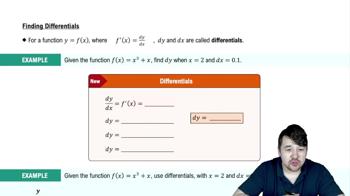
Finding Differentials

Cosine Function

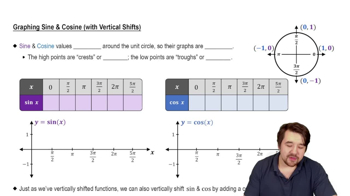
The cosine function is a periodic function that describes the relationship between the angle and the lengths of the sides of a right triangle. In the given daylight function D(t), the cosine term models the seasonal variation in daylight hours, reflecting how daylight changes throughout the year. Understanding its properties, such as periodicity and amplitude, is crucial for interpreting the function's behavior.
추천 영상:
가이드 코스
5:53
Graph of Sine and Cosine Function

Rate of Change

The rate of change refers to how a quantity changes in relation to another variable. In this scenario, it specifically pertains to how the number of daylight hours changes with respect to time (days of the year). By calculating the derivative of D(t), we can determine the instantaneous rate of change of daylight hours at any given day, which is key to answering the question.
추천 영상:
가이드 코스
04:16
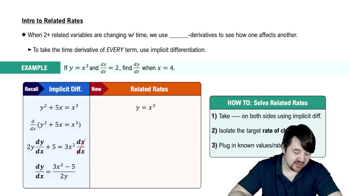
Intro To Related Rates