Ch. 3 - Derivatives
Briggs - Calculus: Early Transcendentals 3rd Edition
Briggs3rd EditionCalculus: Early TranscendentalsISBN: 9780136847243당신이 사용하는 게 아니라요?교과서 변경
3장, 문제 84a

Use the given graphs of f and g to find each derivative. <IMAGE>
d/dx (5f(x)+3g(x)) |x=1

검증된 단계별 안내
1
Step 1: Understand the problem. We need to find the derivative of the function h(x) = 5f(x) + 3g(x) at x = 1, where f and g are functions whose graphs are provided.
Step 2: Apply the linearity of differentiation. The derivative of a sum of functions is the sum of their derivatives. Therefore, d/dx [5f(x) + 3g(x)] = 5 * d/dx [f(x)] + 3 * d/dx [g(x)].
Step 3: Evaluate the derivatives of f and g at x = 1. From the graphs, determine the slopes of the tangent lines to f(x) and g(x) at x = 1, which represent f'(1) and g'(1) respectively.
Step 4: Substitute the values of f'(1) and g'(1) into the expression from Step 2. This gives us 5 * f'(1) + 3 * g'(1).
Step 5: Calculate the final expression using the values obtained from the graphs. This will give the value of the derivative of h(x) at x = 1.

비슷한 문제에 대한 검증된 영상 답변:

이 영상 해법은 위 문제에 도움이 된다고 튜터들이 추천한 것입니다.
영상 길이:
5m

주요 개념

질문에 올바르게 답하기 위해 반드시 이해해야 하는 핵심 개념들은 다음과 같습니다.

Derivative

The derivative of a function measures how the function's output value changes as its input value changes. It is defined as the limit of the average rate of change of the function over an interval as the interval approaches zero. In practical terms, the derivative provides the slope of the tangent line to the graph of the function at a given point.
추천 영상:

Sum Rule of Derivatives

The sum rule states that the derivative of the sum of two functions is equal to the sum of their derivatives. Mathematically, if f(x) and g(x) are differentiable functions, then d/dx [f(x) + g(x)] = f'(x) + g'(x). This rule simplifies the process of finding derivatives when dealing with expressions that involve the addition of multiple functions.
추천 영상:
가이드 코스
05:44
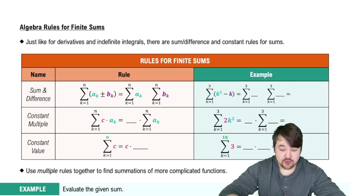
Algebra Rules for Finite Sums

Constant Multiple Rule

The constant multiple rule states that the derivative of a constant multiplied by a function is equal to the constant multiplied by the derivative of the function. Formally, if c is a constant and f(x) is a differentiable function, then d/dx [c * f(x)] = c * f'(x). This rule is essential for differentiating expressions where functions are scaled by constants.
추천 영상:
04:02
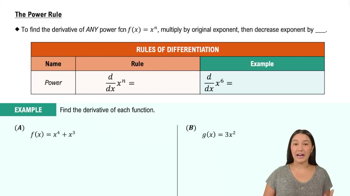
The Power Rule